Gasketed vs Semi-Welded Plate Heat Exchanger: How to Choose
Aiprel
professor
A selection guide for process, refrigeration and HVAC engineers — sealing, cleaning access, pressure, gasket life, standards and total cost, compared side by side.
November 12, 2026
Aiprel Engineering Team
In short: A gasketed plate heat exchanger seals every channel with an elastomer gasket and opens completely for mechanical cleaning. A semi-welded plate heat exchanger (SWHE) laser-welds plate pairs so one circuit has no gasket at all, while the other circuit stays gasketed and openable. Choose gasketed when both fluids are mild and the pack must be opened often; choose semi-welded when one fluid is aggressive, hazardous or high-pressure and the other still needs service access.
Ask three suppliers to quote the same duty and the prices can differ by a third. The thermal calculations usually agree. What differs is the sealing method — and with it the temperature ceiling, the fluids you can run, how the unit is cleaned, and what the next fifteen years of maintenance will cost. The gasketed vs semi-welded plate heat exchanger choice is decided by that difference, not by the heat transfer coefficient.
What is a gasketed plate heat exchanger?
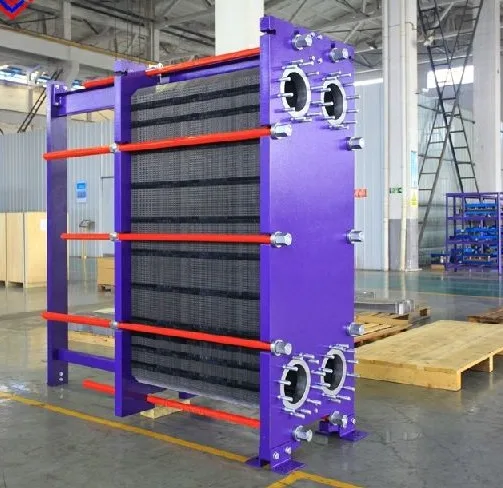
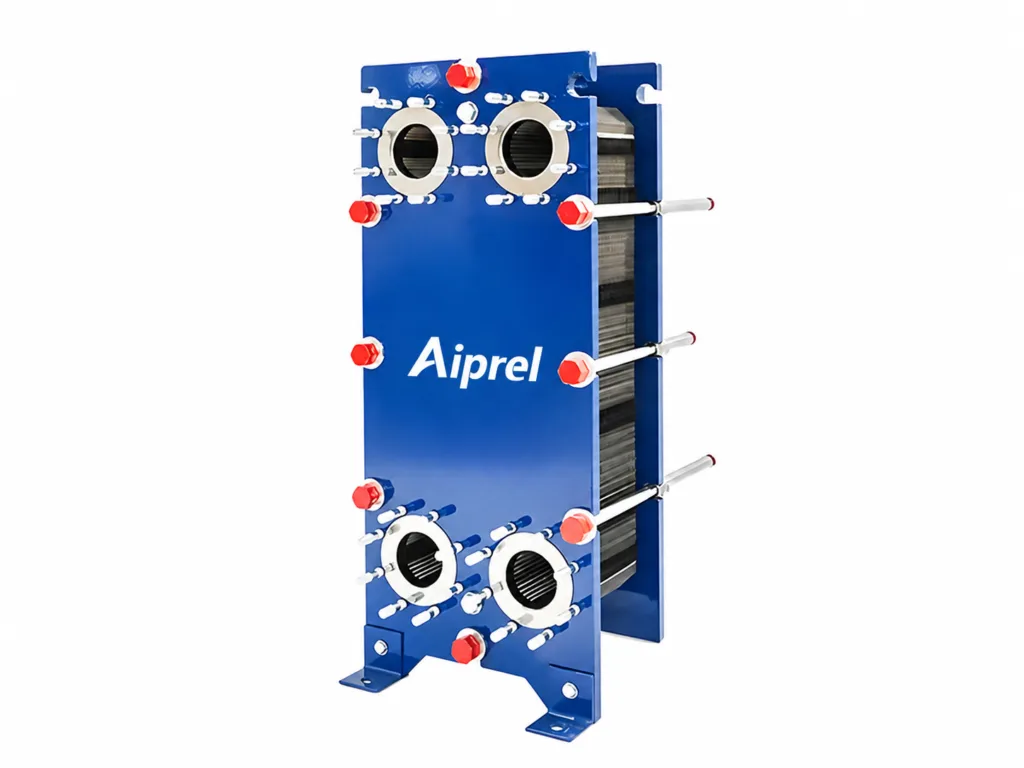
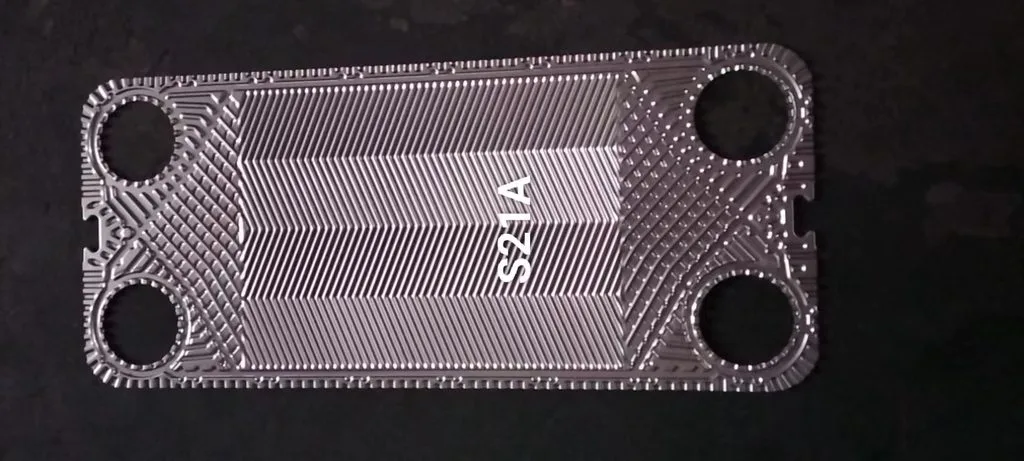
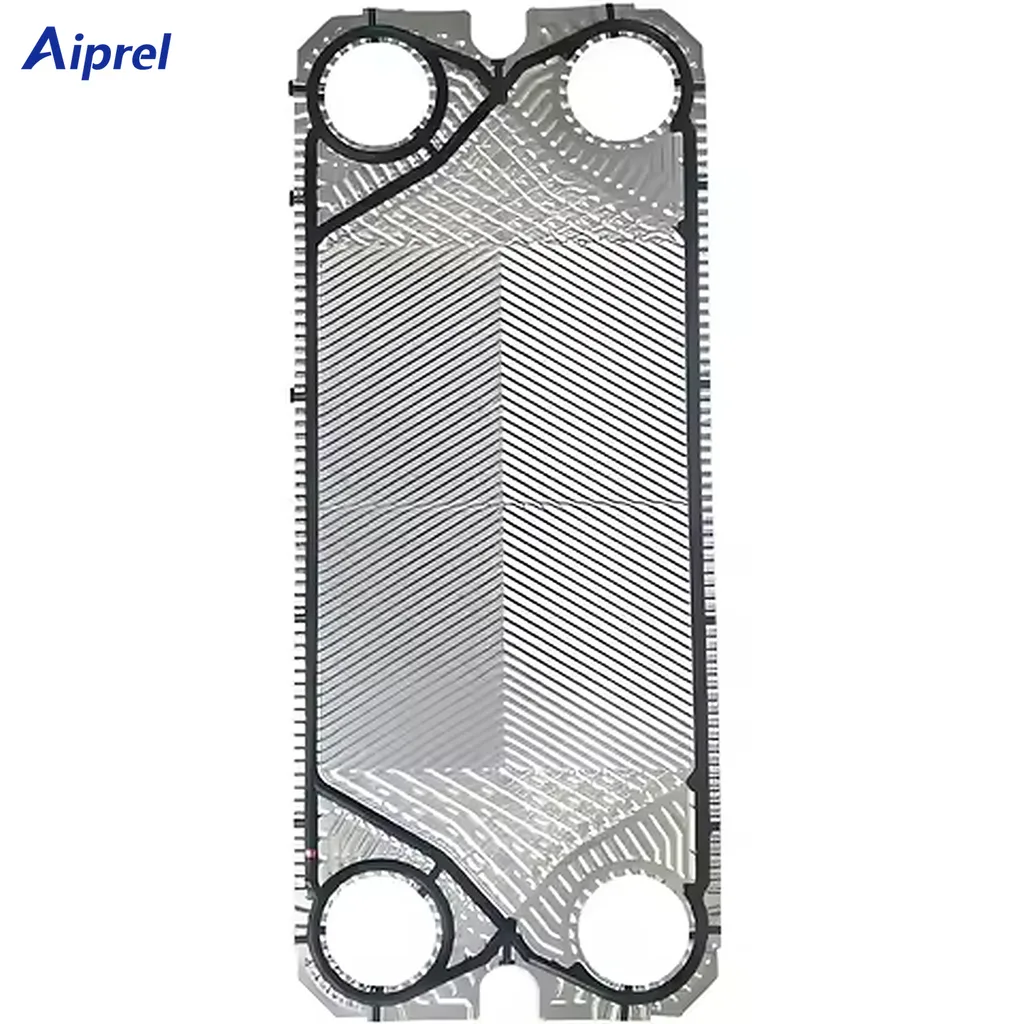
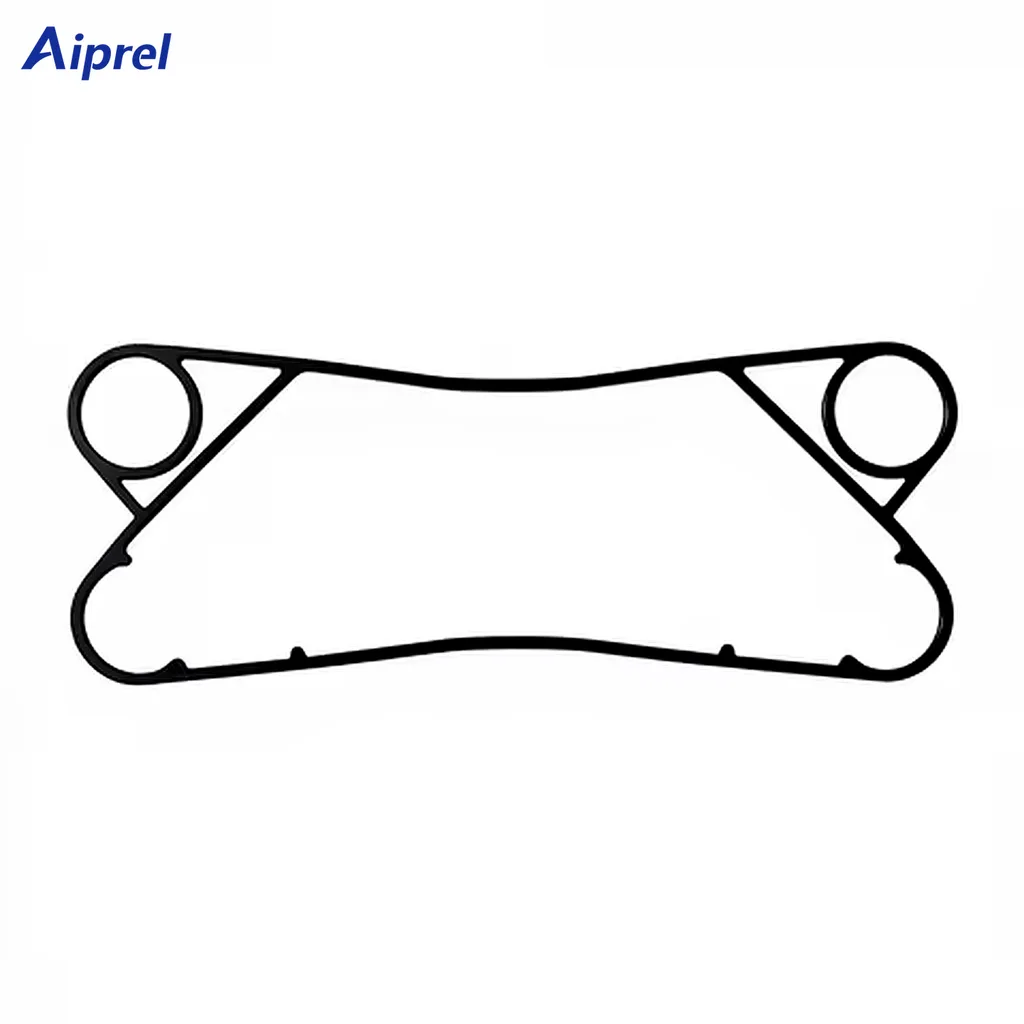
A gasketed plate heat exchanger — also called a gasketed plate-and-frame heat exchanger or GPHE — is a pack of corrugated metal plates compressed between a fixed frame plate and a movable pressure plate. An elastomer gasket sits in a groove around each plate’s perimeter and ports. The gaskets seal alternate channels, keeping the two fluids apart while heat crosses the thin plate wall.
Because the pack is held together by tightening bolts rather than welds, it can be opened in roughly an hour. Plates can be brushed or jet-washed individually, a damaged plate can be replaced, and capacity can be changed by adding or removing plates within the frame’s tightening range. That serviceability is why gasketed units dominate the installed base in HVAC, district heating, food and beverage, and general process cooling. Our gasketed plate heat exchanger range covers those duties from 0.1 to 4,500 m³/h.
The limitation is also the gasket. Every gasket is a wear item and a potential leak path. Elastomer compatibility has to be checked against both the process fluid and the cleaning chemicals — a detail covered in our guide to NBR, EPDM, HNBR and FKM gasket materials.
What is a semi-welded plate heat exchanger?
A semi-welded plate heat exchanger (SWHE) is a hybrid construction. Two plates are laser-welded along the sealing groove to form a cassette. The demanding fluid flows inside the welded cassette, where the boundary between the two fluids is metal. The cassettes are stacked in the frame and sealed to one another with gaskets, so the second fluid runs through conventional gasketed channels.
The result is a deliberate split: no elastomer touches the aggressive medium, while the utility side remains fully serviceable. This is a well-established arrangement in industrial heat transfer: because the aggressive fluid is separated by metal rather than elastomer, welded channels can be designed for higher pressures than a fully gasketed frame. Typical duties include ammonia refrigeration, sulphuric acid and caustic processing, petrochemical streams and industrial heat pumps. Aiprel’s semi-welded plate heat exchanger design uses the same cassette principle with plate options in 304, 316L, titanium, 254 SMO, Hastelloy and nickel.
Both constructions move heat the same way. Fluids run counter-current on opposite sides of a corrugated plate; the corrugations generate turbulence; thin metal keeps resistance low. Published reference ranges put plate-to-plate liquid duties broadly in the 1,000–4,000 W/(m²·K) band depending on fluid pair, velocity and fouling allowance — see the overall heat transfer coefficient table. The sealing method does not move that number materially.
What it changes is the number of gasketed sealing points and which fluid sees them. A semi-welded pack roughly halves the gasketed interfaces of a similarly sized gasketed pack, and — more importantly — places the remaining gaskets on the benign side. That is the whole logic of the design.
Table 1. Gasketed vs semi-welded plate heat exchanger compared
Decision factor
Gasketed plate heat exchanger
Semi-welded plate heat exchanger
Channel sealing
Elastomer gasket in every channel
Laser-welded plate pairs on one circuit; gaskets between cassettes
Gasket exposure to aggressive medium
Direct
None on the welded circuit
Gasketed sealing points
One set per plate pair
Roughly half — between cassettes only
Pack opening
Whole pack opens
Gasketed side opens; welded cassettes stay closed
Mechanical cleaning
Both sides, plate by plate
Gasketed side only; welded side CIP/backflush
Capacity change
Add or remove plates
Add or remove cassettes
Typical industry pressure range quoted
About 10–16 bar for standard frames; higher figures with heavy construction
Commonly quoted 25–30 bar; higher with special designs
Typical industry temperature ceiling
Around 150°C with standard elastomers; higher with FKM/HNBR
Around 200°C on the welded side; gasketed side still elastomer-limited
Aiprel published envelope
0.1–4,500 m³/h; DN32–DN500; up to 3.5 MPaG; up to 180°C; 60 MW
0.1–4,500 m³/h; DN32–DN500; up to 3.5 MPaG; up to 180°C; 60 MW
Leak signature
Weep at frame edge; internal leak possible
Gasketed side visible; welded side metal-tight
Relative purchase cost
Lower
Higher
Best fit
Mild fluids, frequent cleaning, variable duty
One difficult fluid, one serviceable utility side
A caution on the numbers. Industry ranges and individual manufacturers’ datasheets do not always agree. Aiprel lists the same pressure and temperature envelope for both families because the frame and plate design set those limits. That does not make the two interchangeable. The envelope tells you what the unit survives; it does not tell you which fluid touches rubber, or what a leak on that circuit would cost. Always ask which circuit carries the gasket.
How long do plate heat exchanger gaskets last?
Elastomer life is a function of temperature, fluid chemistry and cleaning regime, not a fixed number. A commonly cited service interval is roughly three to eight years before hardening, compression set or cracking makes replacement necessary. Short intervals are not automatically a design fault — a planned replacement is maintenance; an unplanned one is a leak.
Three choices determine how predictable that cycle is: the compound, the attachment method and the closing dimension. Clip-on gaskets remove the adhesive curing step and shorten every future shutdown. The cost of a gasket set is worth modelling over ten years rather than at the purchase order stage. And where a leak appears, external vs internal leaks have different signatures: an internal leak can cross-contaminate two circuits with nothing visible on the floor.
On a semi-welded unit, this entire discussion applies to one side only.
Cleaning and maintenance: the constraint that decides more selections than pressure
A gasketed pack can be opened and every channel mechanically brushed or jet-washed. A semi-welded pack cannot. The welded channels are cleaned by circulating chemical solution — CIP, soak or backflush — and hard scale, crystals or baked-on fouling may not come off. A damaged welded cassette is replaced as a pair, not as a single plate.
This is why the classic selection rule is more precise than “semi-welded is stronger”:
Put the difficult but clean-running fluid in welded channels: ammonia, acid, caustic, solvent, high-pressure gas.
Put the fouling but benign fluid in gasketed channels: cooling tower water, river water, brine, glycol.
If the aggressive stream is also the one that scales heavily, stop and reconsider. A gasketed unit, a wide-gap plate pack or a different exchanger family may serve better than a semi-welded unit you cannot clean.
Ammonia refrigeration: why semi-welded became standard
Ammonia is the reference case for this construction. It is an efficient natural refrigerant with a well-established safety discipline — the International Institute of Ammonia Refrigeration is the central technical authority — but it is toxic, and any copper in the circuit is a problem. Nothing copper-bearing should touch the refrigerant: no brazing filler, no copper ports, no brass instrument fittings. That check belongs in the bill of materials, including small items such as gauge snubbers and thermowells.
A semi-welded evaporator or condenser keeps ammonia inside welded channels and puts water or glycol on the serviceable side. Several design details matter more than the headline duty:
Circulation ratio. Pump-circulated evaporators commonly run at roughly two to four times the evaporated mass flow so channels stay wetted and outlet vapour fraction remains manageable.
Two-phase pressure drop. Boiling channels lose pressure steeply as vapour fraction rises, eroding the temperature difference available at the operating point.
Freeze protection. If a service channel stops flowing while the refrigerant side is still cold, it can freeze and distort plates. Glycol concentration, low-flow interlocks and drainability belong in the design.
Baseline pressure drop. Record clean pressure drop on both sides at commissioning; without a baseline, later fouling judgements are guesses.
The same split applies in process plants. Sulphuric acid cooling, caustic soda service, petrochemical condensation and metallurgical process streams all benefit from a welded barrier on the aggressive side, while the cooling-water side stays open for descaling. Plate material is selected independently for each circuit — stainless 316L, titanium, 254 SMO, Hastelloy or nickel — so the alloy budget goes where chlorides or acid actually attack.
For high-purity or severely corrosive media on both sides, a fully welded construction is more honest than a semi-welded one. For duties where one side needs frequent hygiene inspection, gasketed remains the practical choice.
Fluid assignment: which side goes where
Fluid A — welded side
Fluid B — gasketed side
Hazardous, toxic or expensive
Benign utility water or glycol
Corrosive acid, caustic, solvent
Fouling but cleanable stream
High pressure or deep vacuum
Low-pressure service side
High-purity stream that must not cross-contaminate
Stream requiring periodic inspection
Ammonia, CO₂ cascade, refrigerant
Cooling water, brine, chilled water
A mistake here defeats the purpose of the construction. If the fouling stream is assigned to the welded side, the maintenance advantage disappears. If the aggressive stream is assigned to the gasketed side, the safety advantage disappears.
How each construction fails
A gasketed unit fails at the gasket: a weep at the frame edge, a drifting pressure test, a drip on the floor. It is the cheapest failure to detect and the cheapest to fix, which is why gasketed units remain preferred wherever a small external leak is tolerable.
A semi-welded unit fails either on the gasketed side, in the same visible way, or at a weld or plate crack on the welded side — rarely, but after years of thermal cycling or chloride attack, and expensively. You are trading a frequent, cheap, visible event for a rare, costly one. That is a risk decision, not simply an upgrade.
Standards and documentation to specify
Certification follows the installation location, not the factory. Units installed in North America are commonly assessed to ASME BPVC Section VIII; European installations to the Pressure Equipment Directive; and liquid-to-liquid gasketed units may carry AHRI 400 performance certification. Refrigeration systems are commonly referenced to EN 378, ISO 5149 or IIAR practice for charge and machinery-room rules. AHRI’s certification programme is described on the AHRI Liquid-to-Liquid Heat Exchanger certification page.
Decide this at enquiry stage, because the answer changes plate thickness, test regime and paperwork. Material certificates, pressure and leak test records, the assembled pack dimension and any third-party inspection should be treated as deliverables. On export projects, inspection is normally witnessed before crating, so the test schedule must be agreed early enough to book an inspector.
Six questions that settle the choice
Does either fluid attack common gasket compounds? Include additives and cleaning chemicals, not just the base fluid name.
What happens if this unit leaks? A weep on a water circuit is a maintenance job; the same weep on ammonia is a safety event.
How will each side actually be cleaned? If mechanical brushing is required on the difficult side, semi-welded will disappoint.
What are the pressure and temperature, including cleaning and shutdown peaks? Not just normal operation.
Will capacity grow? Both constructions allow pack changes, but confirm the frame and connections leave room.
What does one unplanned shutdown cost? Compare that with the price difference between the two units.
Where the money actually goes
Per square metre of installed area, gasketed is the cheaper purchase and semi-welded sits above it. Over ten years the order can reverse. The gasketed unit adds gasket sets and opening hours, but capacity can be extended without replacing the frame. The semi-welded unit starts more expensive, removes gasket risk from the difficult circuit, and then mostly stops costing anything there — provided that circuit is kept clean.
The number to model is downtime cost multiplied by expected frequency, plus the cost of the consequence if the leak is not visible. On benign water duty that arithmetic favours gasketed. On ammonia or concentrated acid it usually favours semi-welded regardless of purchase price.
Table 2. First-pass selection by duty
Duty
Starting point
Reason
Chilled and hot water, HVAC
Gasketed
Close approach, openable, expandable
District heating and heat recovery
Gasketed
Small driving temperature difference; plates can be added
Ammonia evaporation or condensation
Semi-welded
No elastomer in the refrigerant circuit; moderate charge
Sulphuric acid, caustic soda
Semi-welded
Removes aggressive medium from gasket contact
Petrochemical and metallurgical processes
Semi-welded
Hazardous streams with one serviceable side
Industrial heat pumps and cascade systems
Semi-welded
Higher design pressure and low refrigerant charge
Food, dairy, beverage
Gasketed, hygienic design
Daily CIP plus periodic inspection
High-purity or severely corrosive media both sides
Fully welded
No elastomer in the pack
High-pressure gas or condensing duty
Welded plate-and-shell
Pressure-vessel containment
Fibrous or particle-laden fluids
Gasketed wide-gap
Larger channels resist blinding
What goes wrong in quotation comparisons
Comparing offers without normalising fouling factor and allowable pressure drop. This worked sizing example shows how far the assumptions move the result.
Choosing a gasket grade on temperature alone, then cleaning with a chemical that grade cannot tolerate.
Treating semi-welded as “slightly more welded” rather than as a different cleaning model.
Using up the full frame on day one, leaving no room to add plates or cassettes.
Comparing literature values rather than the manufacturer’s confirmed datasheet for your model and design code.
What to send us for an accurate selection
Send the heat duty in kW or flow rate in kg/h, inlet and outlet temperatures on both sides, fluid properties (density, viscosity, specific heat, concentration, solids content), allowable pressure drop per side, design pressure and temperature, applicable design code, material and gasket preference, connection sizes and orientation, cleaning method and frequency, and installation limits including plate-pack withdrawal space.
Our plate heat exchanger range covers gasketed, semi-welded and fully welded plate-and-frame units, welded plate-and-shell, wide-gap packs and marine configurations, with replacement gaskets and replacement plates for equipment already in service. Dimensions and materials are in the catalogue. If you would rather start from the duty than the hardware, send us the process data and we will tell you which construction fits — including when the honest answer is gasketed rather than semi-welded.
Frequently asked questions
What is the difference between a gasketed and a semi-welded plate heat exchanger?
A gasketed unit seals every channel with an elastomer gasket and opens completely. A semi-welded unit laser-welds plate pairs so one circuit has no gasket; only the other circuit remains gasketed and openable.
Is semi-welded the same as fully welded?
No. Semi-welded keeps gaskets between welded cassettes on one side. A fully welded unit has no elastomer in the plate pack and cannot be opened for mechanical cleaning.
Can a semi-welded plate heat exchanger handle ammonia?
Yes. Ammonia evaporation, condensation, desuperheating and cascade duties are core applications. Welded channels contain the refrigerant, reducing both charge and the risk of leakage to atmosphere.
Does semi-welded allow higher pressure than gasketed?
Usually yes, because the welded cassette removes the gasket from the high-pressure circuit. The exact rating depends on plate pattern, material and design code; confirm it on the datasheet for your model.
Can welded channels be mechanically cleaned?
No. They can be cleaned in place or backflushed, but not opened and brushed. Hard scale or fibre deposits are the main reason to reconsider the construction.
How long do gaskets last on a plate heat exchanger?
It depends on compound, temperature, fluid and cleaning regime. A commonly cited range is three to eight years; confirm the grade and its continuous limit for your duty.
Is gasketed cheaper over its lifetime?
On benign duties, usually yes. Where the gasket is the limiting component, avoided downtime and avoided leak consequence typically outweigh the higher purchase price of semi-welded.
Can an existing gasketed unit be converted to semi-welded?
No. Plate pairs, grooves and frames are different. The decision belongs at specification stage.
The choice, in one line
Gasketed when both fluids can live with a gasket and the pack must be opened; semi-welded when one fluid cannot and the other side still needs access; fully welded when neither fluid can. Everything else — brand, plate count, price per square metre — is a second-order decision made after that fork is right.
Aiprel builds gasketed, semi-welded and fully welded constructions from one production base, so the recommendation does not depend on what happens to be in stock. Send the duty and the constraints, and the selection can be argued on media compatibility, pressure, cleaning and total cost rather than on preference.