Marine Plate Heat Exchanger: A Design Guide for Seawater Corrosion and Vibration
Aiprel
professor
A marine plate heat exchanger is rarely a standard industrial unit with a different paint finish. On board a vessel it becomes the component that decides whether your central cooling loop keeps running, or whether a pitting leak puts the engine room on reduced load in the middle of a passage.
Shipyards and marine engineers keep running into the same failure pattern: a gasketed plate heat exchanger specified for land-based duty is installed in a seawater circuit, and within one or two docking cycles the plates show pitting, the gaskets weep, and the clamping bolts have lost torque.
The root cause is almost never a single bad component. It is a design that was never balanced against two conditions that never switch off at sea: chloride-driven corrosion and continuous vibration fatigue. This guide walks through the design decisions in the order they actually matter — material, gasket, plate pattern, frame, mounting and certification — so that a specification can be checked item by item before the purchase order is signed.
Why Marine Duty Breaks Standard Heat Exchangers
Land-based installations assume a stable foundation, a controlled water chemistry and maintenance access at any time. A ship offers none of the three. Two load cases dominate, and both are cumulative rather than instantaneous.
Seawater corrosion: pitting, crevice and galvanic attack
Chloride is the primary aggressor. At typical seawater concentrations of around 19,000 mg/L chloride, the passive film on stainless steel becomes locally unstable, and pitting initiates at surface defects, weld seams and under deposits. Once marine organisms attach and form a fouling layer, the area beneath becomes oxygen-depleted and a crevice cell develops — corrosion then accelerates in exactly the place that is hardest to inspect.
Galvanic corrosion is the second, and it is usually self-inflicted. Whenever a titanium plate bundle is bolted to a carbon steel pipe spool, or a stainless flange meets a copper alloy strainer, the less noble metal becomes the anode. The rate depends on the area ratio: a small anodic area coupled to a large cathodic area corrodes very fast. This is why isolation kits at the connections are not an optional accessory on a marine unit.
The most expensive mistake in this category is assuming 316L is “marine grade”. It is not, in a seawater sense. Grade 316L is a reasonable choice for closed freshwater and freshwater-glycol circuits, but it should not be used for permanent direct seawater service.
Vibration and shock loads in the engine room
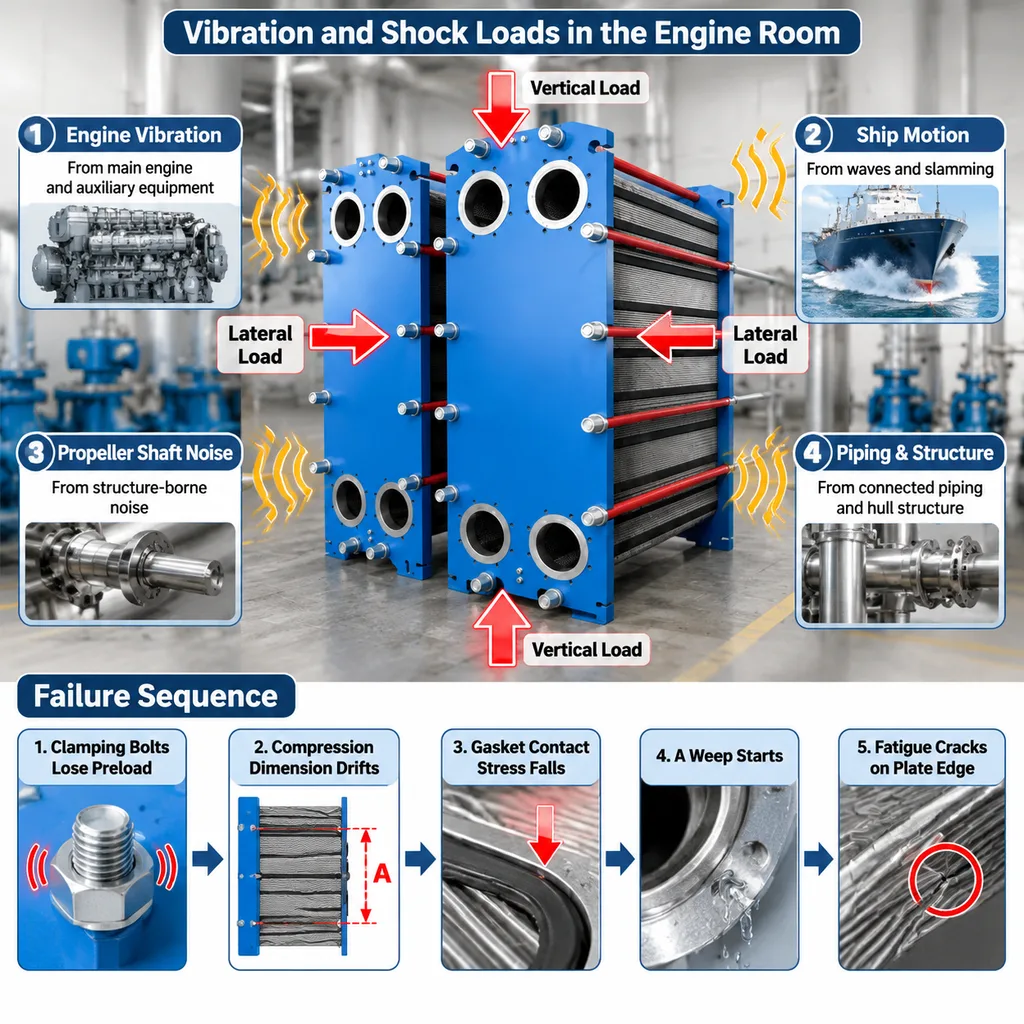
Vibration arrives from four directions at once: main engine harmonic excitation, pressure pulsation from seawater pumps, hull roll and slamming, and structure-borne noise from the propeller shaft line. A plate heat exchanger is particularly exposed because its sealing function depends on a compressive load held by bolts — and bolts are exactly what vibration loosens.
The failure sequence is predictable. Clamping bolts slowly lose preload, the plate bundle compression dimension drifts below the design A-dimension, gasket contact stress falls off, and a weep starts. If the unit happens to sit on a structural natural frequency, the corrugation peaks see reversed bending and fatigue cracks can initiate along the plate edge long before any leak appears.
Classification and type-approval requirements
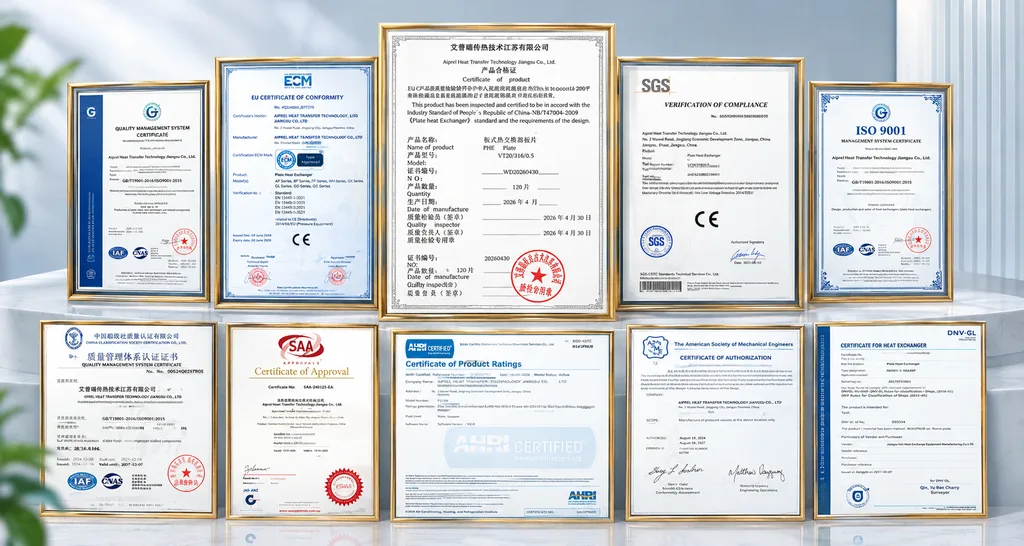
Marine equipment is approved, not just purchased. A unit installed in a classed vessel typically needs type approval or design appraisal from a classification society — CCS, DNV or Lloyd’s Register depending on the flag and the owner’s preference — and must satisfy SOLAS requirements for the systems it serves.
Tender documents frequently require the certificate at the specification stage, before any hardware is ordered. A land-based exchanger cannot simply be re-purposed, because the approval is tied to the design, the material certificates and the manufacturing quality system.
Plate Material Selection for Seawater Duty
Material selection is where most of the total cost is decided, and where the cheapest option usually becomes the most expensive one. The practical choice is a three-tier decision.
Titanium Grade 2: the default for continuous seawater
Grade 2 titanium is the reference material for continuous seawater cooling loops. Its passive oxide layer is self-healing in aerated seawater, which means a scratch or a light abrasion re-passivates instead of becoming a pitting site.
It is immune to chloride stress corrosion cracking at engine room temperatures and tolerates the intermittent chlorination used for biofouling control. Thermal conductivity is lower than stainless steel, but because titanium allows thinner plates the overall heat transfer coefficient usually stays within a few percent of an equivalent stainless design.
Super duplex 2507: the budget-conscious alternative
Super duplex 2507 — with roughly 25% chromium, 7% nickel and 3.5% molybdenum — sits between 316L and titanium in both performance and price. It handles chlorinated seawater reasonably well when the duty is intermittent: closed-loop cooling that is flushed after use, harbour service, or a seawater circuit that runs only during maneuvering.
It is a defensible choice where budget is tight and the operating profile is genuinely intermittent. It is not a defensible choice for a continuously wetted seawater circuit on a working vessel, where crevice corrosion under fouling remains the dominant risk.
Where 316L stops being acceptable
Grade 316L remains valid for freshwater, freshwater-glycol and lube-oil circuits, and for seawater only as a short-duration flush path. Specifying it for permanent seawater exposure to save cost shifts the failure to year two or three, when the unit is out of warranty and the plates must be replaced in a dockyard at short notice.
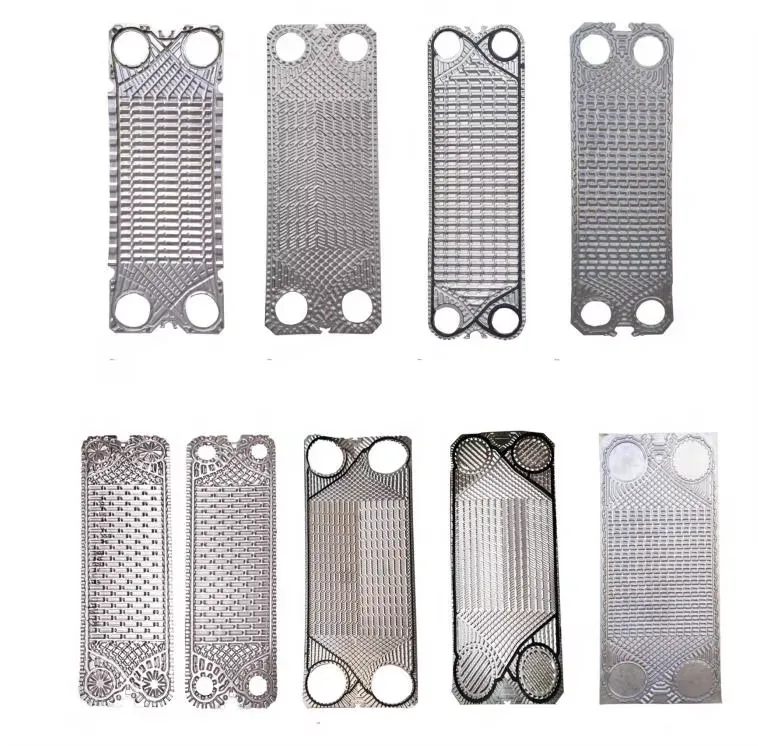
When plates do fail, replacing the bundle is normally far cheaper than replacing the unit. We supply titanium replacement plates compatible with the plate patterns of most mainstream marine PHE models, which keeps a repair inside one docking window instead of a new-build lead time.
Gasket Selection for Marine Service
Gaskets are the component most often downgraded to save a few percent of unit cost, and the one that generates the most unplanned downtime. Elastomer choice and gasket retention style both matter, and they solve different problems.
Why standard EPDM falls short
EPDM is an excellent general-purpose gasket material — until it meets the combination of 80–90 °C engine room air temperature, continuous seawater immersion and occasional oil mist from a nearby leak. Under that combination it hardens, takes a permanent compression set and loses the elasticity needed to follow plate movement. The result is a weep that appears at the plate edge rather than at the port, which makes it hard to trace.
HNBR and FKM for marine duty
For marine service, HNBR or FKM (Viton) grade gaskets are the preferred specification. HNBR offers the better balance for seawater plus lube oil exposure and remains serviceable across the usual engine room temperature range. FKM extends the temperature ceiling and resists fuel and lubricant contamination better, at higher cost and with slightly less low-temperature flexibility.
Retention style matters as much as the compound. A glued gasket is bonded into the plate groove; under sustained vibration and thermal cycling the bond line creeps, the gasket lifts at the corners and eventually peels away from the groove. A clip-on gasket is mechanically retained in the groove and stays seated through the same duty.
For engine room installations this is not a marginal difference — it is the difference between a gasket that survives five years and one that needs re-gasketing at the first opportunity. We compared both designs in clip-on vs glued plate heat exchanger gaskets, including the re-gasketing time each style costs during a docking.
Plate Pattern and Channel Design
The plate pattern sets the velocity field, and the velocity field sets both the heat transfer coefficient and the erosion rate. Marine designs are tuned for a narrower operating window than land-based units, because both fouling and vibration are permanent conditions rather than occasional ones.
Corrugation angle and velocity distribution
A shallower corrugation angle gives a lower pressure drop but also a lower wall shear stress, which lets biofilm and scale establish. A steeper angle raises turbulence and keeps the surface cleaner but increases pump head and erosion risk at the ports.
Marine units are usually specified with a mixed-angle configuration — high-angle passes in the seawater channel to maintain shear, softer angles on the closed loop side to protect the pump budget. The objective is uniform velocity across the whole channel width: local high-velocity bands erode the plate, while low-velocity dead zones become fouling nurseries.
Fouling, marine growth and cleaning windows
Seawater channels foul faster than any other duty, and the cleaning interval is a design output rather than a maintenance afterthought. Good marine practice is to design for chemical cleaning in place without dismantling the bundle, and to keep enough plate spare capacity that a fouled unit still meets the duty until the next planned maintenance window. If the unit is already
running at its thermal limit when clean, fouling will force an unplanned shutdown.
Fatigue-optimised corrugation geometry
Rounded transitions at the corrugation peaks reduce stress concentration where the plate is clamped and where reversed bending occurs. It is also worth checking that the plate profile’s natural frequencies sit away from the dominant engine harmonic bands, because a plate resonating at the second-order firing frequency will fail at the edge long before its corrosion allowance is consumed.
When the decision is between re-plating and replacing the whole exchanger — a common question once a bundle has been cleaned and inspected — the economic cut-off usually depends on frame condition and plate pattern availability rather than on the plate price itself. We covered that decision path in when to replace plates vs replace the whole heat exchanger.
Frame, Bolting and Vibration Isolation
The frame does not touch seawater in normal operation, which is why it is often under-designed. In practice the frame and the mounting interface are what keep the sealing system alive under vibration.
Reinforced frames and anti-loosening studs
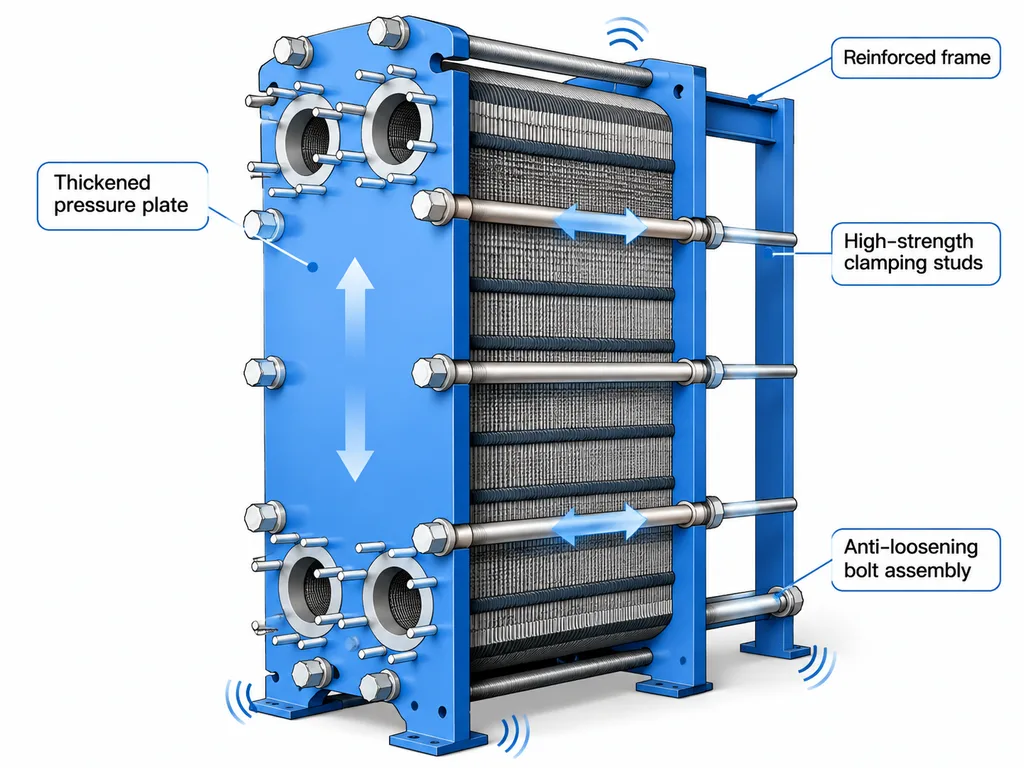
Thickened pressure plates, high-strength clamping studs and anti-loosening hardware work together to hold torque under continuous excitation. Standard hardware with a single spring washer is not sufficient: preload loss on a marine unit is progressive, and once it starts it accelerates. Any marine specification should state the required bolt torque, the tightening sequence and the re-torque interval after the first commissioning week.
Bundle compression control
The A-dimension — the measured stack height of the clamped bundle — is the only practical field check that the gasket is at its design compression. Marine units should be delivered with the A-dimension marked on the frame and recorded in the commissioning documentation, so that a later re-torque can be verified against a known baseline instead of guesswork.
Mounting bases and elastic isolators
Custom support bases with elastic isolators break the structure-borne vibration path from the hull into the exchanger. This is not only a reliability measure: classification societies require tilt and shock load capability, and the mounting arrangement is part of what gets reviewed during design appraisal.
Certification and Compliance
A marine plate heat exchanger is delivered with a documentation package, not just hardware. At minimum, expect material certificates traceable to the heat numbers, pressure test reports, a type approval certificate or design appraisal from the relevant classification society, and a declaration covering the SOLAS requirements applicable to the system.
The commercial argument for checking this early is simple. If the certificate is requested at the tender stage and the selected supplier cannot produce it, the schedule absorbs the delay — not the supplier. Verification should include the exact model, the plate material and the gasket compound named on the certificate, because approvals are granted to a specific configuration, not to a product family in general.
Marine PHE Specification Checklist
Use this list to review a quotation before it becomes a purchase order:
Plate material matched to duty: Grade 2 titanium for continuous seawater; super duplex 2507 only where service is genuinely intermittent.
Gasket compound matched to media list: HNBR or FKM, never standard EPDM for seawater plus elevated engine room temperature.
Gasket retention: clip-on, not glued, for any high-vibration location.
Frame and bolting: reinforced pressure plates, anti-loosening studs, documented torque values and A-dimension.
Mounting: support base with elastic isolators, verified against tilt and shock requirements.
Certification: type approval or design appraisal from CCS, DNV or LR, covering the exact configuration offered.
Spares philosophy: one set of titanium plates and marine-grade gaskets carried on board for critical circuits.
Service access: cleaning-in-place connections, and a realistic fouling allowance in the thermal design.
Frequently Asked Questions
These are the questions that come up most often during specification reviews and pre-purchase checks.
What plate material is best for a seawater cooling circuit?
Titanium Grade 2 for continuous service. It is the only common plate material that stays passive and self-healing in continuously wetted seawater, and it tolerates biofouling chlorination. Super duplex 2507 is acceptable for intermittent seawater duty where the budget rules out titanium.
Can a standard industrial plate heat exchanger be used on a ship?
Only after the design has been reviewed for both corrosion and vibration, and only if it can obtain classification approval. In practice that means different plate material, different gasket compound and retention, reinforced clamping hardware and a documented mounting arrangement — which usually adds up to a different unit, not a modified one.
How often do marine PHE plates need cleaning?
It depends on the seawater quality and the fouling allowance built into the thermal design, but most working vessels plan a chemical clean every 6 to 12 months and a full inspection at each special survey. If the unit needs cleaning more often than that, the channel velocity or the fouling margin is probably wrong.
Which gasket material should I specify — HNBR or FKM?
HNBR where the media are seawater and lube oil at moderate engine room temperature; FKM where fuel contamination or higher temperatures are expected. Both should be clip-on retained for marine duty.
Is it worth keeping spare plates on board?
For critical circuits, yes. A titanium plate set and a gasket set carried on board convert a potential off-hire event into a few hours of maintenance. If you are unsure which parts match your existing unit, our guide on how to choose the right plate heat exchanger replacement parts explains how to identify plates and gaskets from the nameplate, the plate pattern or the A-dimension.
Conclusion
A reliable marine plate heat exchanger is not simply a titanium plate pack. It is a balanced system: corrosion-resistant plates, a gasket compound and retention style that survive heat and vibration, a corrugation geometry that keeps velocity uniform without eroding the plate, a frame that holds preload, and a mounting arrangement that keeps hull vibration out of the bundle.
Get those five elements aligned and the unit becomes unremarkable — which is exactly what you want from cooling equipment at sea.
If you are specifying a unit for a newbuild, or looking for compatible plates and marine-grade gaskets for an existing onboard exchanger, send your working conditions over to our thermal engineers — flow rate, inlet temperatures, seawater chloride level, engine room ambient and classification requirement — and we will check the selection against the duty.