Gasketed vs Brazed vs Welded: Which Plate Heat Exchanger to Choose?
Aiprel
professor
A selection guide for process, HVAC and refrigeration engineers — and the five questions that settle the choice before an enquiry goes out.
Ask three suppliers to quote the same duty and the prices can differ by a third. Every one of them can be technically correct. The gap is rarely margin: it is the sealing method. A gasketed vs brazed vs welded plate heat exchanger is the same technology in three different commitments, and the commitment you sign up to decides the temperature ceiling, the fluids you can run, whether the unit can ever be opened, and what the next fifteen years of maintenance will cost.
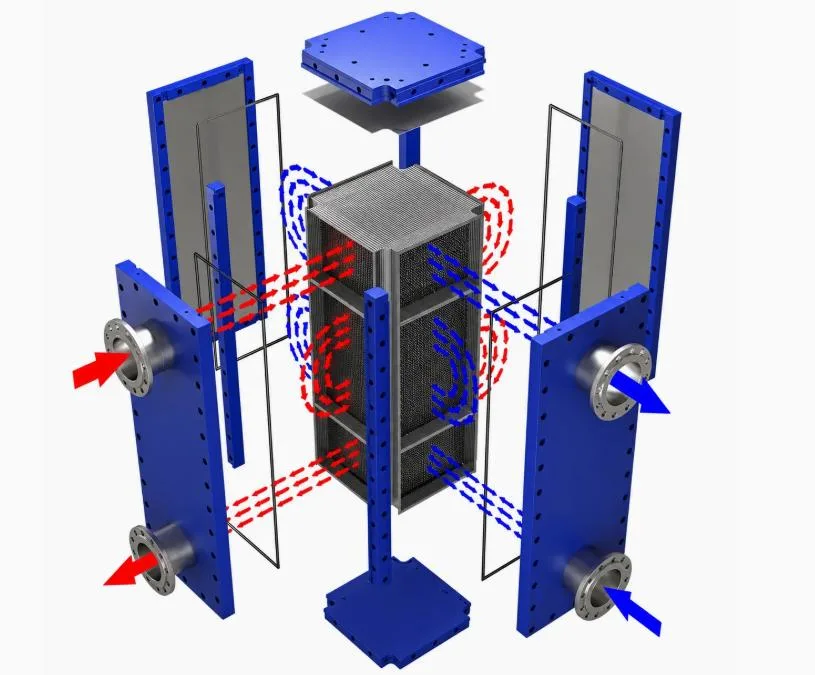
All three designs do the same physical job — two fluids on either side of a thin corrugated metal wall, heat crossing it counter-current. The physics does not change. What changes is how the channels are closed, and therefore who has to open them later, and with what.
The quick answer
Gasketed — the default for general industry: HVAC, district heating, food and beverage, heat recovery, engine and oil cooling. Roughly 120–170°C and 6–25 bar, openable in about an hour, expandable by adding plates. Choose it whenever access matters.
Brazed — the default for compact, sealed, clean circuits: heat pumps, chillers, refrigeration condensers and evaporators, small potable and solar duties. Lowest hold-up volume, lowest installed cost at small capacities, and no service access at all.
Welded — the default when the elastomer is the limiting component: aggressive or hazardous media, high temperature, high pressure, ammonia. Semi-welded keeps one side openable; fully welded and plate-and-shell remove the gasket entirely.
There is also a fourth option that most comparisons skip, and it is often the best value: the semi-welded unit, where welded plate pairs carry the aggressive circuit while the utility side stays gasketed and openable.
What actually differs between the three designs
Every plate heat exchanger uses the same working principle. For clean water duties, all three constructions reach overall heat transfer coefficients in the region of 3,000–6,000 W/(m²·K); the spread comes from plate pattern, flow velocity and fouling allowance, not from the sealing method. A useful cross-check on how U-values move with fluid pairing is this reference table of overall heat transfer coefficients.
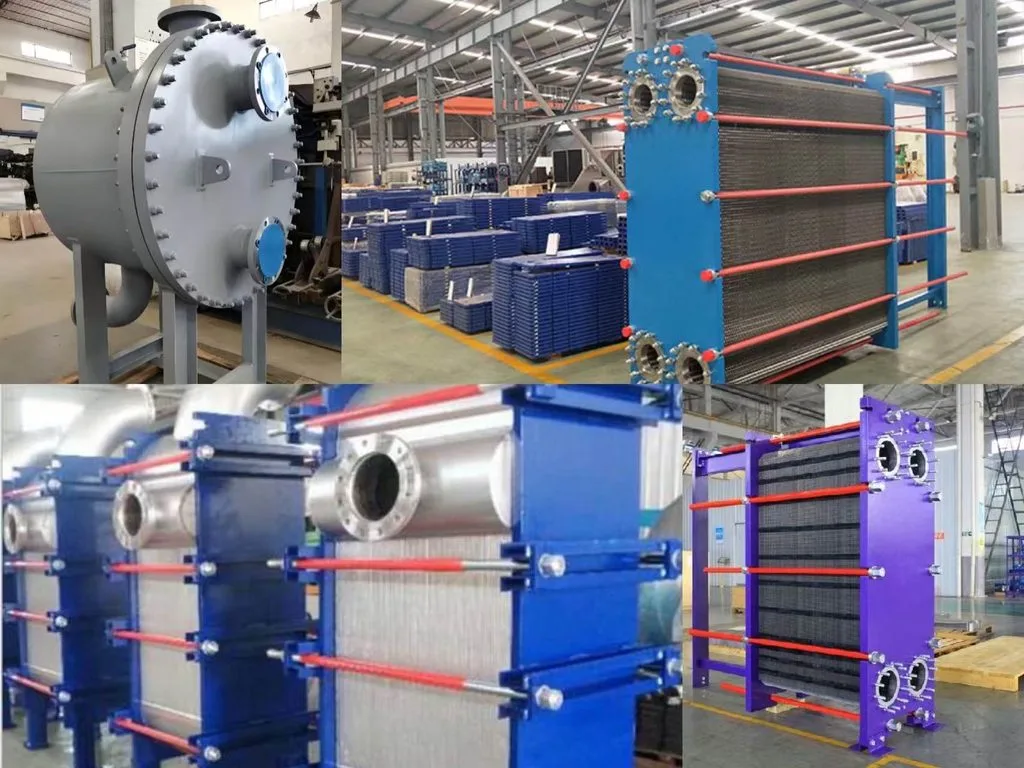
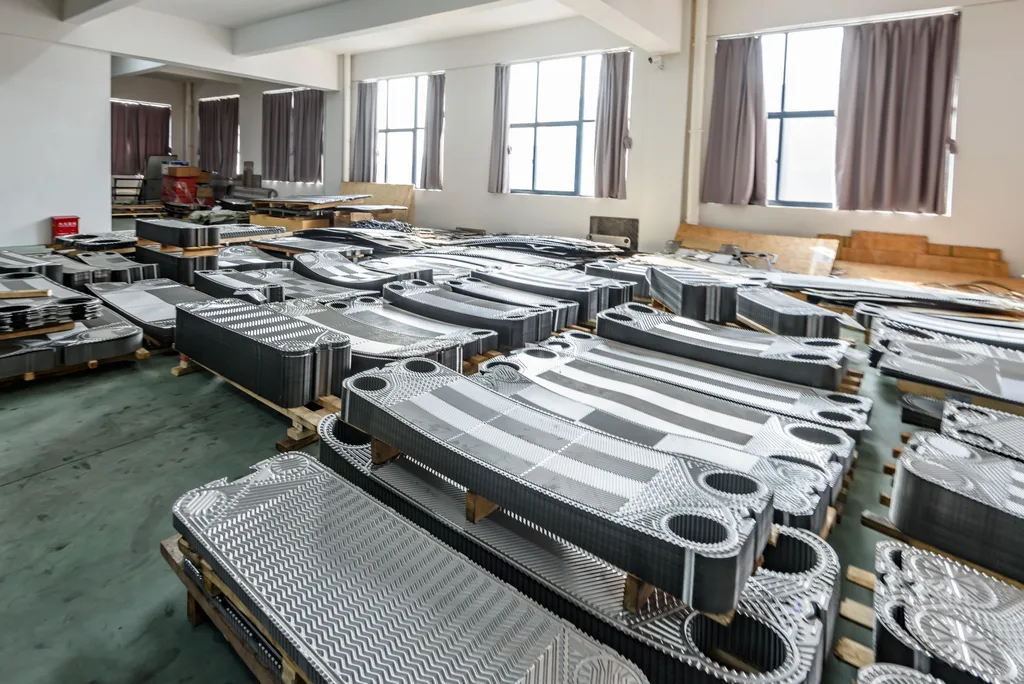
Gasketed. The plate pack hangs on carrying bars between a fixed frame plate and a movable pressure plate. An elastomer gasket sits in a groove around the perimeter of each plate and around the port openings. The pack is compressed with tightening bolts to a calculated dimension, and the gasket seals channel against channel. Loosen the bolts, move the pressure plate back, and the pack opens.
Brazed. The plates are stacked with brazing foil between them and joined in a vacuum furnace. Copper is the usual filler; nickel is used where copper is unacceptable in the process. The filler both bonds the plates and seals every channel, so there is no frame, no bolts and no elastomer anywhere in the unit.
Welded. Plate pairs are welded together, usually by laser, so that the barrier between the two process fluids is metal. In a semi-welded design the welded pairs are then gasketed to each other, which keeps one circuit entirely gasket-free while the other stays accessible. In a fully welded plate-and-frame or welded plate-and-shell design, no elastomer is used at all.
Table 1. Gasketed, brazed and welded plate heat exchangers compared
Criterion
Gasketed
Brazed
Welded
How channels are sealed
Elastomer gasket compressed in a groove
Brazing filler (copper or nickel) bonds and seals the pack
Welded seam; metal barrier between circuits
Typical design pressure
6–25 bar (heavy-duty frames at the upper end)
16–30 bar
25–40 bar plate-and-frame; higher in plate-and-shell
Typical operating temperature
120–170°C, set by the gasket grade
Around 200°C copper-brazed; higher with nickel brazing
To ~300°C in welded plate-and-frame; plate-and-shell extends beyond 400°C depending on materials
Can it be opened
Yes, in about an hour
No
No; semi-welded units open on the gasketed side only
Mechanical cleaning
Brush, jet or wipe individual plates
CIP or backflush only
CIP only
Capacity change after commissioning
Yes, add plates within the frame limit
No
No
Fouling tolerance
Moderate; wide-gap plates for fibrous or slurry duties
Low; narrow channels and small ports block
Moderate; designed around CIP
Ammonia service
Compatible with the correct gasket grade
Copper-brazed: no; nickel-brazed: limited
Yes
Internal hold-up volume
Higher
Lowest
Low to moderate
Field repairability
Gasket and plate replacement on site
Replace the unit
Limited; usually factory service
Relative cost per m² of area
Lowest
Low at small capacities
Highest
Gasketed: the default when access matters
Most plate heat exchangers in service are gasketed, and the reason is access rather than price. The unit opens in about an hour. The pack can be inspected, plates brushed or jet-washed, a damaged plate replaced, and the pack re-torqued to its dimension. Capacity can be raised by adding plates, provided the frame, the nozzle sizes and the allowable pressure drop leave room for it. Close temperature approaches of 1–2°C make gasketed units the standard choice in heat recovery, where the driving temperature difference is small and every degree counts.
The gasket is the wear item, and that is not a design defect — it is designed to be replaced. A planned replacement is maintenance; an unplanned one is a leak. Two decisions determine how well this works in practice: the elastomer grade and the plate pattern. NBR, EPDM, HNBR and FKM cover different temperatures and chemistries, and the selection depends as much on the cleaning chemicals used during CIP as on the process fluid itself. Clip-on gaskets have largely displaced glued types because a plate can be re-gasketed without a curing step, which shortens every future shutdown. The cost of a gasket set is worth modelling over ten years rather than comparing only at the purchase order stage.
Where the design runs out of room: above roughly 170°C the elastomer choice narrows quickly; above 25 bar the frame and plate geometry become expensive; solvents, amines and some concentrated chemicals attack the gasket itself; and toxic or flammable fluids are harder to justify because a gasket failure is, by definition, a leak to atmosphere — even when it is a visible and predictable one. Channels of 2–4 mm also blind with fibres, pulp and slurries, which is where a wide-gap plate pack solves the problem without changing the frame or the duty.
When a gasket does fail, the useful question is where the leak sits rather than which part to order. External and internal leaks have different signatures and different consequences, and an internal leak can cross-contaminate two circuits without any visible sign on the floor.
Brazed: compact, sealed for life
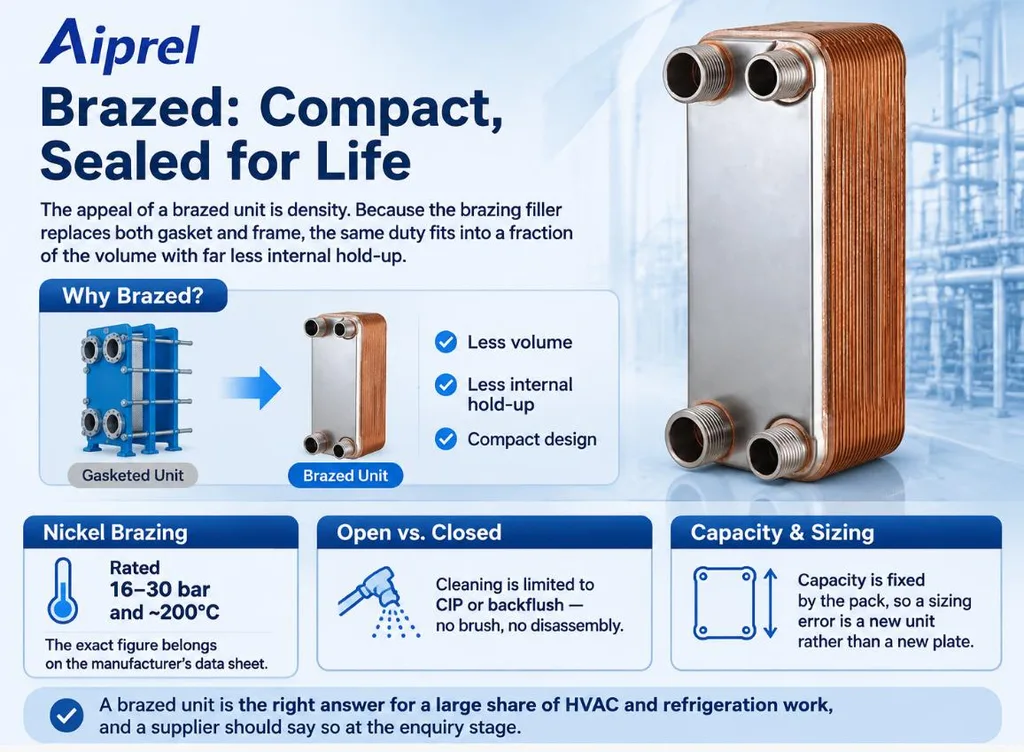
The appeal of a brazed unit is density. Because the brazing filler replaces both gasket and frame, the same duty fits into a fraction of the volume with far less internal hold-up. In refrigeration and heat pump work that matters twice: less refrigerant charge per kilowatt, and shorter pipe runs inside a packaged unit. As refrigerants move toward lower-GWP and mildly flammable blends, charge reduction stops being a nice-to-have and becomes part of the compliance case for the whole system.
Nickel brazing is the variant worth knowing. It removes copper from the circuit, which copper-brazed units cannot tolerate in ammonia service or in some sulphur-bearing and amine-containing media, and it raises the practical temperature ceiling. Copper-brazed units are typically rated 16–30 bar and around 200°C; nickel-brazed versions go higher. The exact figure belongs on the manufacturer’s data sheet, not in a rule of thumb.
What a brazed unit cannot do is open. Cleaning is limited to CIP or backflush, so the duty must be one that dissolves or disperses rather than one that deposits fibres, crystals or hard scale that needs a brush. Capacity is fixed when the pack leaves the furnace, so a sizing error is a new unit rather than a new plate. A damaged channel is not repairable in the field.
Worth saying plainly: brazed units are the right answer for a large share of HVAC and refrigeration work, and a supplier who builds only gasketed and welded equipment should say so at the enquiry stage. If your duty points to brazed, take it to a brazed specialist rather than accepting an oversized gasketed frame as a substitute.
Welded: when the gasket itself is the risk
A welded unit exists because the elastomer is the limiting component. It caps temperature, it restricts chemistry, and it creates a leak path by design. Removing it removes all three constraints at once, at the cost of access.
Three constructions cover different problems. A semi-welded unit welds plate pairs and gaskets the pairs to each other: the aggressive side — ammonia, a refrigerant, a chloride stream — sees only metal, while the utility side stays openable for cleaning. A fully welded plate-and-frame unit closes both circuits with metal and is cleaned by CIP. A welded plate-and-shell unit puts the plate pack inside a pressure vessel, which is how plate technology reaches the pressure and temperature range of shell-and-tube equipment while keeping a fraction of the footprint.
The trade-offs are real and should be stated at the quotation stage: no mechanical cleaning, no inspection without opening the circuit, no capacity change, a higher cost per square metre, and repairs that usually happen in a workshop rather than on site. A welded unit is chosen for what it can survive, not for what it can be adjusted to.
How each family fails, and what that costs
Failure modes are worth comparing because they set the shape of the risk. A gasketed unit fails at the gasket, visibly and usually gradually — a weep at the frame edge, a pressure test that drifts, a drip on the floor. It is the cheapest failure to detect and the cheapest to fix, which is why gasketed units are preferred wherever the fluid is hazardous but the consequence of a small external leak is tolerable. A brazed unit fails internally, between circuits, with no external sign until contamination or performance loss shows up; there is no repair, only replacement. A welded unit fails at a weld or a plate crack, rarely, and typically after years of thermal cycling or chloride stress — the failure is slow to arrive and expensive when it does, but it arrives far less often than a gasket does.
Five questions to settle before you choose
1. Does the fluid attack elastomers?
Solvents, amines, high-aromatic oils, chlorine dioxide and some concentrated acids rule out standard gasket grades. Check compatibility first; if the answer is marginal, the welded family is the safer route. Remember too that CIP chemicals are part of the fluid envelope.
2. Is the duty above 170°C or above 25 bar?
If either limit is exceeded, the gasket is no longer a candidate and the decision moves to welded construction — not to a different gasket. Check the excursion, not the average: a 90°C duty with a weekly 135°C sterilisation cycle is a 135°C gasket selection.
3. How will the plates actually be cleaned?
If the fouling needs a brush, a gasketed pack is the only construction that allows it. If CIP is already the plant standard, a welded or brazed unit fits the maintenance regime instead of fighting it.
4. Will the duty change within five years?
Production lines grow. A gasketed frame with spare plate capacity costs little at the start and avoids a second unit later; a brazed or welded pack cannot be extended at all.
5. What happens when it leaks?
Product contamination, refrigerant loss, or personnel exposure changes the answer. Where the consequence is severe, the metal-sealed option is usually cheaper than the risk it removes.
Where the money actually goes
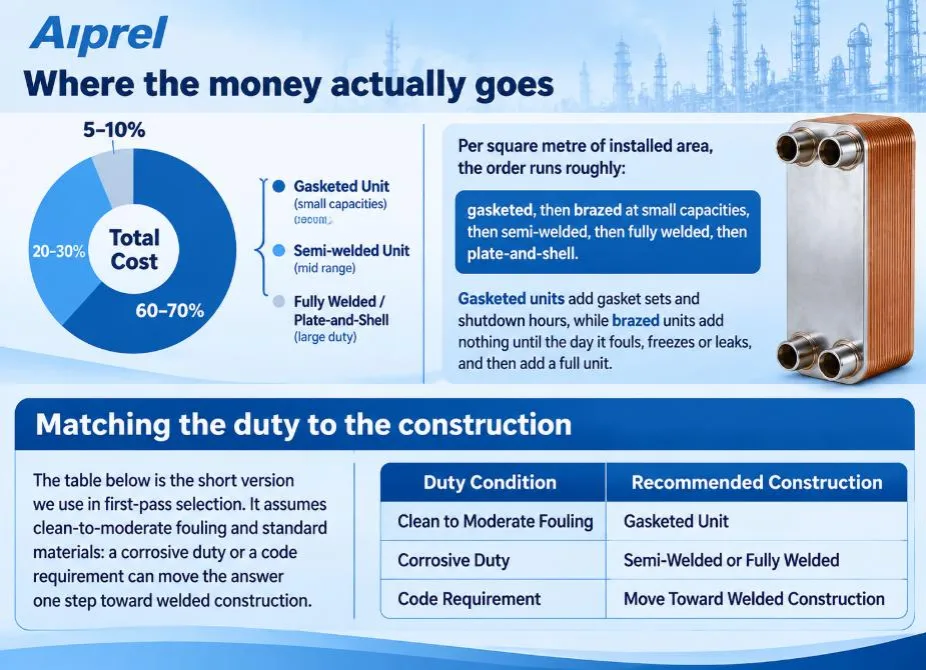
Per square metre of installed area, the order runs roughly: gasketed, then brazed at small capacities, then semi-welded, then fully welded, then plate-and-shell. That is also the order in which most buyers stop thinking, because the first number on the page is the cheapest one.
Over ten years the order often reverses. The gasketed unit adds gasket sets and shutdown hours but never needs replacing for capacity; the brazed unit adds nothing until the day it fouls, freezes or leaks, and then adds a full unit; the welded unit starts expensive and then mostly stops costing anything, which is why it is frequently the cheapest option over life in chemical and refinery duty. The number to model is downtime cost multiplied by frequency, not the price of a gasket set.
Matching the duty to the construction
The table below is the short version we use in first-pass selection. It assumes clean-to-moderate fouling and standard materials; a corrosive duty or a code requirement can move the answer one step toward welded construction.
Table 2. First-pass construction selection by duty
Duty
Recommended construction
Reason
Chilled and hot water, HVAC
Gasketed
Close approach, openable for cleaning, expandable
District heating and heat recovery
Gasketed
Small driving temperature difference; pack can be extended
Heat pump, chiller, refrigeration (HFC/HFO)
Brazed
Lowest charge and hold-up, compact, no gaskets to maintain
Ammonia refrigeration
Semi-welded or fully welded
Copper-free circuit, metal seal on the ammonia side
Domestic hot water, potable circuits
Brazed double-wall or gasketed
Double wall gives a detectable gap between the circuits
Food, dairy, beverage
Gasketed, hygienic design
Daily CIP plus periodic visual inspection of the pack
Aggressive chemicals, high-purity media
Semi-welded or fully welded
Elastomer removed from the aggressive circuit
Thermal oil and high-temperature duties
Fully welded
No elastomer in the temperature path
High-pressure gas, condensing duty
Welded plate-and-shell
Pressure-vessel containment around the plate pack
Marine seawater cooling
Gasketed with titanium plates, or welded
Corrosion allowance traded against cleanability
Data centre CDU and compact skids
Brazed or welded
Footprint and charge matter more than service access
What goes wrong in quotation comparisons
Comparing offers without normalising the fouling factor and the allowable pressure drop. Two units with the same area and different assumptions are not the same unit; this worked sizing example shows how far the assumptions move the result.
Specifying a brazed unit for a fluid that will eventually block channels of two millimetres. It works for the first season and fails in the second.
Choosing the gasket grade on temperature alone, then cleaning with a chemical the same grade cannot tolerate. Compatibility has to be checked against the cleaning regime, not only the process fluid.
Using up the full frame on day one, leaving no room to add plates when the load grows. The cheapest unit at commissioning is often the most expensive one at expansion.
Treating “welded” as one product. Semi-welded, fully welded plate-and-frame and plate-and-shell sit at different points on the cost and pressure scale, and quoting them as equivalents wastes everyone’s time.
Replacing plates in a pack whose gasket grooves and frame faces are already worn, then blaming the plates. Plates versus the whole unit is a separate decision from gaskets versus plates.
What to send us for an accurate selection
To size and select a unit properly, send the heat duty in kW or the flow rate in kg/h, the inlet and outlet temperatures on both sides, the fluid properties (density, viscosity, specific heat, concentration and solids content), the allowable pressure drop per side, the design pressure and temperature, the required design code, the material and gasket preference, the connection sizes and orientation, the cleaning method and frequency, and any installation limits such as footprint, lifting capacity and the space needed to withdraw the plate pack.
Our plate heat exchanger range covers gasketed, semi-welded and fully welded plate-and-frame units, welded plate-and-shell units, wide-gap packs and marine configurations, with replacement gaskets and plates for equipment already in service. Capacities, dimensions and materials are listed in the catalogue. If you would rather start from the duty than from the hardware, send us the process data and we will tell you which construction fits — including when the honest answer is a brazed unit, which we do not build.
Frequently asked questions
Can a brazed plate heat exchanger be cleaned mechanically?
No. The brazed pack cannot be opened, so cleaning is limited to CIP or backflush and works only on foulants that dissolve or disperse. A duty that needs brushing belongs in a gasketed frame.
Is a welded plate heat exchanger more efficient than a gasketed one?
Not in any way that changes a selection. With the same plate pattern and velocity, the overall coefficient is comparable. Welding changes the pressure, temperature and chemistry limits; it does not change the heat transfer.
What temperature can a gasketed plate heat exchanger handle?
It depends on the gasket grade: standard NBR to roughly 110–120°C, EPDM to about 150–170°C, and FKM or special compounds higher. The governing figure is the peak process temperature including sterilisation and upset cycles, not the average duty.
Can plates be added to a welded unit later?
No. Capacity is fixed when the pack is welded. If load growth is credible, choose a gasketed frame with spare plate capacity instead, or accept that expansion means a second unit.
Which construction is cheapest?
Per square metre of installed area, gasketed is usually the lowest and welded the highest. On small duties the brazed unit often wins on total installed cost because it eliminates the frame, the foundation and the refrigerant charge a larger unit would need.
Why choose semi-welded instead of fully welded?
When only one circuit is aggressive, hazardous or volatile. Welding only that side keeps the other side openable for cleaning and typically costs well below a fully welded equivalent, while removing the elastomer exactly where it would fail.
The choice, in one line
Gasketed if you need to open it; brazed if you need it small and will never open it; welded if the fluid, the temperature or the pressure would destroy a gasket. Everything else — brand, plate count, price per square metre — is a second-order decision made after that fork is right.
Aiprel supplies all three sealing families except brazed, from one production base, so the recommendation does not depend on what happens to be in stock. Send the duty and the constraints, and the selection can be argued on pressure, temperature, cleaning and total cost rather than on preference.
Get In Touch With Us
Need pricing? Need samples? Need support? Talk with our team in 24h.