How to Choose the RightPlate Heat ExchangerReplacement Parts
Aiprel
professor
A replacement plate may look identical to the one removed from your heat exchanger. A gasket may appear to have the same outline. Neither observation is enough to confirm that the part is suitable.
Small differences in plate geometry, port positions, gasket profiles or materials can affect assembly, sealing and operation. The right replacement must match the relevant equipment configuration and withstand the conditions in which it will be used.
For maintenance teams and purchasing departments, the most reliable starting point is a clear record of the equipment, the required components and the operating conditions. This guide explains what to collect, what to check and what to confirm before placing an order.
Identify What Actually Needs Replacing
Start by defining the scope of the purchase. Do you need individual plates, selected gaskets, a complete gasket set or a maintenance package containing several component types?
Then establish why the parts are being replaced.
External leakage, reduced heat transfer and increased pressure drop can have different causes. Fouling, contamination, assembly conditions and changes in flow may also affect performance. Ordering new components before investigating the problem can leave the underlying issue unresolved.
Record where the problem occurs, when it started and whether the equipment was recently cleaned, opened or reassembled. Note any visible deformation, corrosion, cracks or gasket damage.
Inspection and dismantling should follow the equipment’s maintenance procedures, including isolation, depressurisation and cooling before work begins.
Step 1: Gather the Equipment Identification Details
Accurate identification usually begins with documentation.
Collect the equipment nameplate information, original drawings, parts list and maintenance records. A previous order for parts that were confirmed suitable may also provide a useful reference, provided the equipment configuration has not changed.
If documentation is incomplete, take clear photographs of:
The complete unit and its connection arrangement.
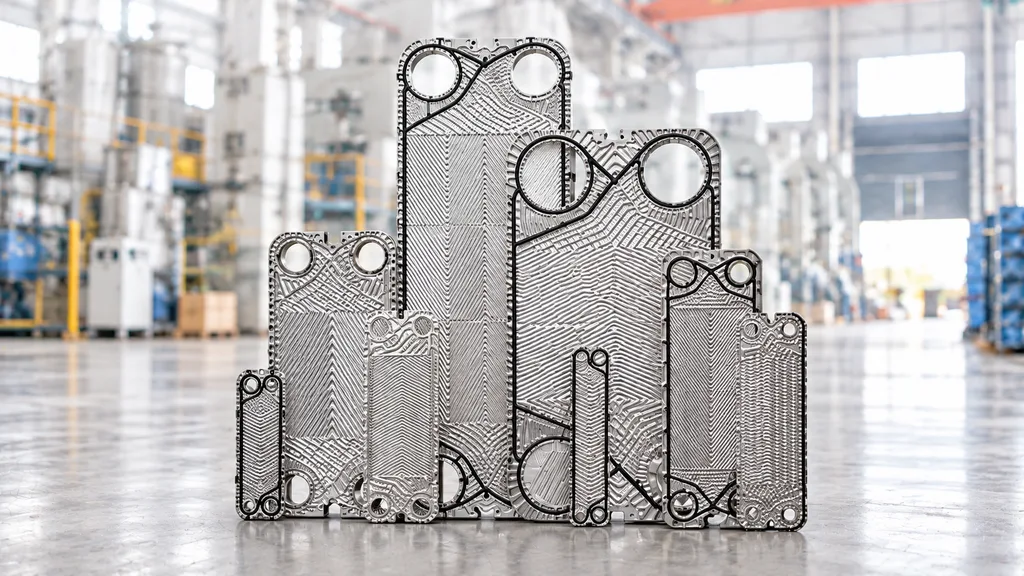
Both sides of a representative plate.
Any visible component markings.
The complete gasket outline.
Gasket grooves, attachment points and damaged areas.
Photograph components as squarely as possible and include a readable dimensional reference. Close-up photographs help explain individual features, but they should accompany an overall view.
Mark uncertain information as “to be confirmed.” An estimated dimension presented as an exact measurement can create more problems than a clearly identified gap in the enquiry.
Confirm port diameters, centre-to-centre distances, hanging features and locating details. These features must work with the existing frame and plate arrangement.
Record measurement units and reference points. A drawing with clearly marked dimensions is generally easier to interpret than an unlabelled list of numbers.
Corrugation and Channel Geometry
The corrugation pattern, pressing depth and plate configuration influence fluid flow, heat transfer and pressure drop.
Two plates with the same outline may therefore perform differently. Some plate packs also use a deliberate combination of plate patterns. Replacement parts should preserve the required configuration unless a technical review establishes a different arrangement.
Hole Configuration and Plate Position
Identify where each required plate sits within the plate pack. Different positions may require different opening or sealing arrangements.
Do not assume that every plate in the unit can be ordered under one specification simply because the external shape is the same.
Material and Thickness
Specify the required plate material and thickness. Material selection should account for the process fluids, concentration, temperature and cleaning conditions.
“Stainless steel” alone is not a complete material specification. Similarly, a thicker plate is not automatically the right replacement.
If the original plate is badly corroded or distorted, its measured dimensions should be checked against other available evidence.
Step 3: Match the Gasket Profile and Material
Choosing replacement heat exchanger gaskets requires two separate checks: whether the gasket fits the plate and whether its material suits the service.
For fit, examine the complete outline, sealing cross-section, port sealing areas and attachment features. Where adhesive is required, confirm the appropriate adhesive and installation procedure.
For material selection, provide both process fluids, their concentrations, normal and maximum operating temperatures, and cleaning conditions.
A general rubber category does not fully define a gasket compound. Colour, appearance and flexibility are also insufficient to establish suitability.
Used gaskets may have stretched, shrunk, swollen or developed permanent compression deformation. A sample can help identify the design, but critical dimensions should be checked against the plate groove or technical documentation.
Replacement Parts Enquiry Checklist
Use the following table when preparing an enquiry or reviewing a supplier’s proposed specification.
Checkpoint
Information to Provide
What It Helps Confirm
Equipment identification
Nameplate details, drawings, parts lists and maintenance records
The original equipment configuration
Purchase scope
Component types, quantities and reason for replacement
Which parts are actually required
Plate dimensions
Length, width, port diameters, port centres and locating features
Basic assembly requirements
Plate geometry
Photographs of both sides, corrugation details and hole arrangement
The required plate configuration
Plate material
Material specification, thickness and fluid information
Suitability for the intended service
Gasket profile
Outline, cross-section, attachment points and groove details
Sealing and locating requirements
Gasket material
Compound requirements, temperatures and fluid composition
Material suitability
Operating conditions
Temperatures, pressures, flow rates and concentrations on both sides
Whether the existing specification remains appropriate
Cleaning conditions
Chemicals, concentrations, temperatures and cleaning frequency
Compatibility with cleaning procedures
Acceptance criteria
Approved drawings, specifications and agreed inspections
A shared basis for checking the delivered parts
Not every enquiry will begin with a complete set of documents. Identify missing items first, then agree whether additional measurements, photographs or samples are needed.
What If Original Drawings Are Unavailable?
An existing plate or gasket can provide useful identification evidence. Before sending a sample, explain its condition and service history.
Tell the supplier whether it has been used for an extended period, exposed to cleaning chemicals, repaired or visibly deformed. These details affect how the sample should be interpreted.
For a first purchase or an uncertain identification, consider confirming a sample before committing to a production quantity. Agree in advance which dimensions, structural features and documents will be checked.
A successful trial fit confirms only part of the requirement. It does not, by itself, establish material suitability or long-term operating reliability.
Compare Specifications Before Comparing Prices
Two quotations described as “replacement plates” or “replacement gaskets” may cover different specifications.
Compare plate material and thickness, gasket requirements, component quantities, inspection scope and delivery documentation. List different plate or gasket configurations separately rather than combining them into one general item.
Also confirm component identification, packaging, delivery dates and the drawing or specification revision that will govern acceptance.
If the process fluid, temperature or production load has changed, repeating an old purchase order may no longer be appropriate. Review the current operating requirements using a plate heat exchanger selection guide before deciding whether the original materials and configuration should be retained.
Inspect Delivered Parts Before Installation
On arrival, check quantities, identification, visible condition and the agreed dimensions.
Inspect plates for deformation and damage. Check gasket outlines, sealing profiles and attachment features. Resolve any damage or specification discrepancy before installation.
During assembly, follow the equipment maintenance instructions for plate sequence, orientation, sealing-surface cleanliness, gasket positioning and plate-pack compression. Do not rely solely on how the unit appeared before dismantling.
Complete the applicable inspection and testing procedures before returning the equipment to service, and retain the records for future maintenance.
Start With a Clear Replacement Parts Enquiry
A useful enquiry brings together four things: equipment identification, the required parts and quantities, clear photographs, and operating and cleaning conditions.
When submitting a replacement parts enquiry, state whether the purchase is for routine stock, fault repair or a planned shutdown. List any dimensions or material details that still need confirmation.
Clear information gives the supplier a better basis for identifying the component and helps the purchasing team evaluate the proposal before committing to an order.
Get In Touch With Us
Need pricing? Need samples? Need support? Talk with our team in 24h.