Plate Heat Exchangers for Marine
Aiprel supplies marine plate heat exchangers for central cooling, jacket water, lubricating oil, HVAC, refrigeration and seawater applications.

How Marine Plate Heat Exchangers Work
A marine plate heat exchanger transfers heat between two fluids flowing through separate channels. Corrugated plates create turbulence and provide a large heat transfer area, while gaskets or welded joints keep the media separated.
In a typical shipboard central cooling system, seawater removes heat from a closed freshwater circuit through the exchanger. The freshwater then cools engines, generators, lubricating oil and other onboard equipment.
This arrangement limits direct seawater exposure to selected components and allows the freshwater circuit to be treated and controlled independently.
Marine Plate Heat Exchanger Applications

Central Freshwater Cooling
A central cooler transfers heat from the vessel's closed freshwater circuit to seawater. The freshwater loop can then serve propulsion machinery, generator engines, compressors and other equipment.Keeping seawater within a limited part of the cooling system can reduce corrosion and deposits elsewhere in the engine room. It can also simplify water treatment and maintenance on the internal circuit.The exchanger must be sized for the vessel's peak simultaneous cooling load and the highest specified seawater inlet temperature. Flow balance, redundancy and the consequences of one unit being offline should be considered during system design.
Main and Auxiliary Engine Jacket-Water Cooling
Engine jacket water removes heat from cylinder liners, heads and other engine components. A plate heat exchanger cools this recirculating water against a lower-temperature freshwater or seawater circuit, depending on the vessel's cooling arrangement.Stable jacket-water temperature supports reliable engine operation. The exchanger selection should consider minimum and maximum engine load, coolant additives, target outlet temperature and pressure drop permitted by the engine cooling pump.
Lubricating-Oil Cooling
Propulsion engines, generator sets and other rotating equipment require controlled lubricating-oil temperature. If the oil becomes too hot, its viscosity and lubricating performance can change.A marine plate heat exchanger transfers heat from the oil to a freshwater cooling circuit. Oil viscosity varies strongly with temperature, so thermal calculations should use fluid properties across the operating range rather than treating the oil like water.Plate pattern and channel configuration must also balance pressure drop with sufficient flow velocity. The plate and gasket materials need to be compatible with the exact lubricant and its additives.
Gearbox and Transmission-Oil Cooling
Marine reduction gears, thrusters and transmission systems generate heat during operation. A compact plate heat exchanger can cool gearbox oil using the vessel's central freshwater circuit.This application benefits from the exchanger's small footprint, particularly in propulsion spaces where access is restricted. Design information should include oil type, normal and maximum oil temperature, viscosity, load range and the allowable pressure loss.
Marine HVAC and Chilled-Water Systems
Passenger spaces, accommodation areas, control rooms and equipment rooms require dependable air conditioning. Plate heat exchangers can isolate chilled-water circuits, transfer heat between separate water loops or connect onboard HVAC systems to seawater-based heat rejection.Hydraulic separation allows each loop to operate with its own pressure, water treatment and pump control. The exchanger can also serve different zones or equipment packages while keeping the main chilled-water network protected.
Marine Refrigeration
Vessels use refrigeration for provisions, cargo, process loads and air conditioning. Plate heat exchangers may serve as liquid coolers, condensers, evaporators or intermediate loop exchangers when the selected construction is suitable for the refrigerant and operating conditions.Refrigeration duties require complete information about the refrigerant, phase change, oil content, superheat or subcooling and design pressure. A standard water-to-water selection cannot be applied to a refrigerant duty without recalculation.
Related Products
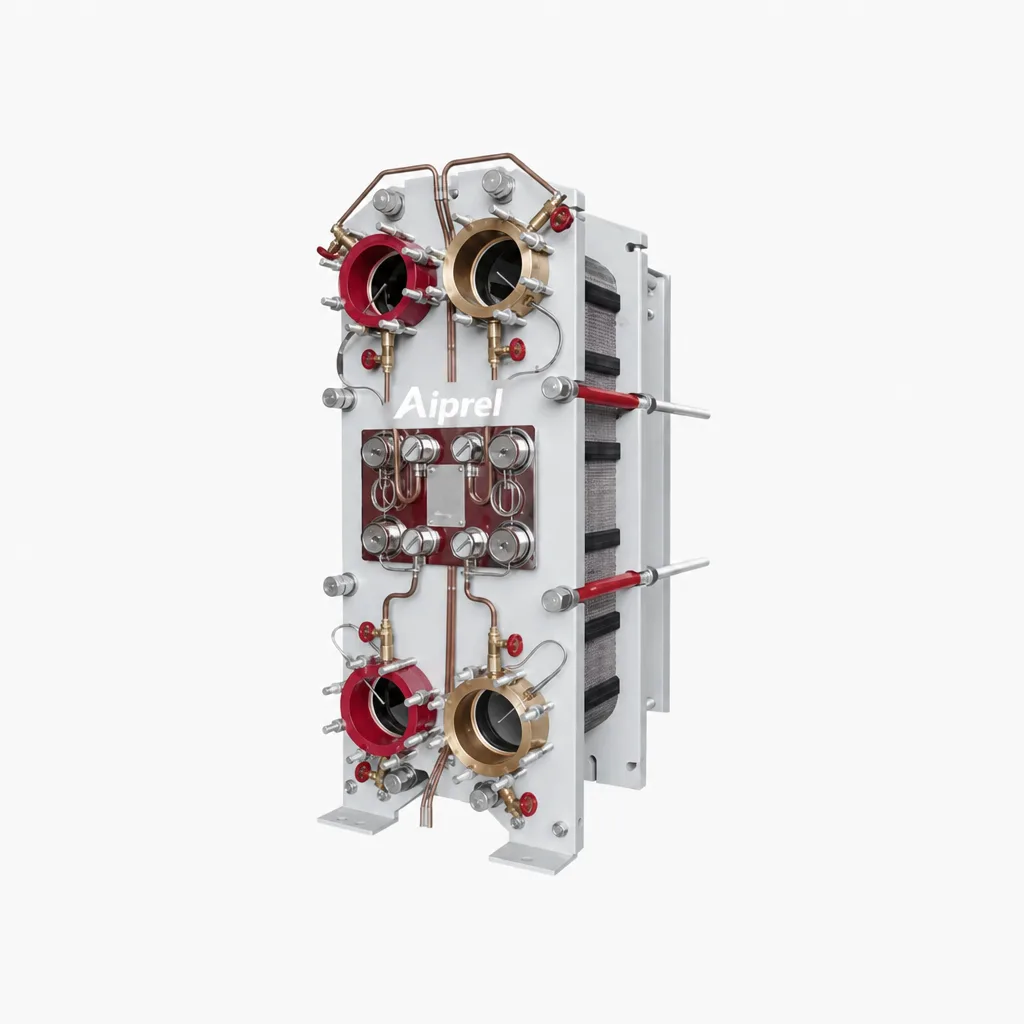
Marine Plate Heat Exchanger
Marine plate heat exchangers are essential components in shipboard cooling, heating, condensing and evaporation systems. By transferring heat efficiently between two fluids, they help maintain stable operating temperatures, improve energy efficiency and protect critical marine equipment.