What is the difference between a wide gap and a standard plate heat exchanger?
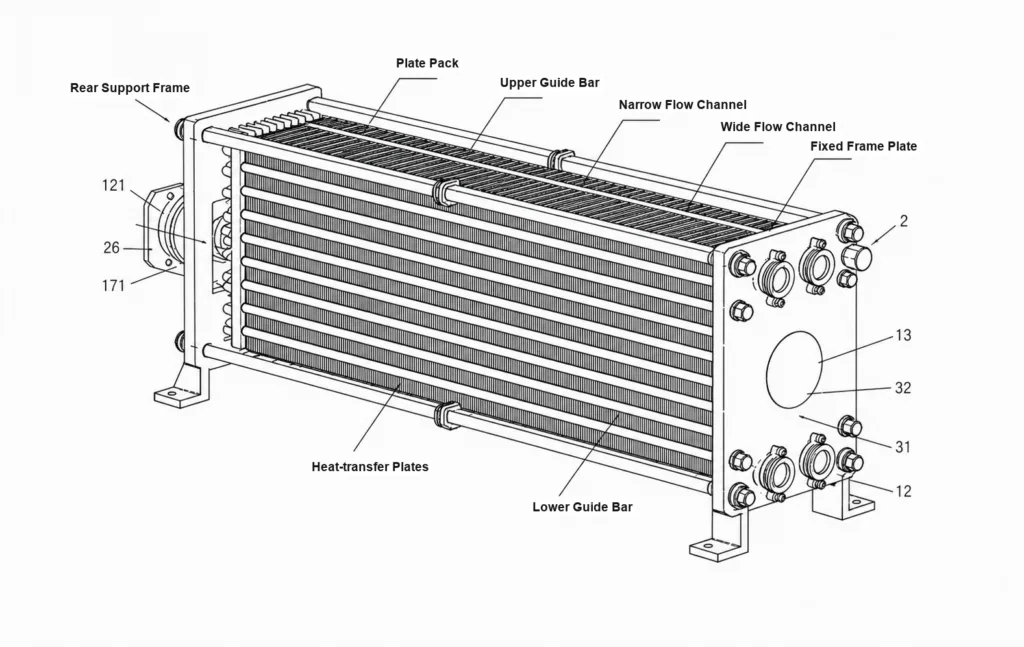
The main difference is the channel geometry. A wide gap unit has deeper and more open passages, while a standard unit has narrower channels optimized primarily for clean fluids.
What fluids can a wide gap plate heat exchanger handle?
It can process selected slurries, pulpy liquids, fermentation mash, molasses, sludge, fiber-containing wastewater and other viscous or solids-containing media. Suitability depends on particle size, fiber length, viscosity and solids concentration.
Does a wide gap design completely prevent clogging?
No heat exchanger is completely clog-free. Wider channels and smoother flow passages reduce the risk, but correct sizing, velocity control, filtration and cleaning remain important.
What are wide-wide channels?
Wide-wide construction provides enlarged channels on both sides of the plate pack. It is suitable when both fluids contain fibers, particles or high-viscosity components.
What are wide-narrow channels?
Wide-narrow construction provides an enlarged channel for the difficult process fluid and a narrower channel for the clean utility fluid. It is useful when the two fluids have different flow rates or pressure-drop requirements.
Can it handle large particles?
It can handle larger particles than a standard plate heat exchanger, but the maximum permissible size depends on the free channel gap, port diameter, particle shape and solids concentration.
Is it suitable for fibrous fluids?
Yes. Wide gap plate heat exchangers are specifically designed for many fiber-containing process fluids. Fiber length, flexibility and concentration must still be evaluated during selection.
Can it handle high-viscosity liquids?
Yes, provided the viscosity, flow rate, pressure drop and operating temperature are included in the thermal and hydraulic calculation.
Can a wide gap heat exchanger be used for heat recovery?
Yes. Counter-current flow and wide-wide channel configurations make it suitable for recovering heat from selected dirty, fibrous or viscous process streams.
How is a wide gap plate heat exchanger cleaned?
It can be cleaned through CIP circulation or by opening the plate pack for mechanical cleaning. The correct method depends on the deposit and compatibility of the plate and gasket materials.
Can the heat transfer capacity be increased later?
Capacity can often be increased by adding plates, provided the frame, connections and hydraulic design have sufficient allowance.
Is a wide gap plate heat exchanger suitable for food processing?
It can be used for pulpy juices, purées, plant-based beverages and other foods containing fibers or particles when hygienic materials, surface finish, connections and compliant gaskets are specified.
What information is required for selection?
Selection requires fluid properties, temperatures, flow rates, pressure, allowable pressure drop, viscosity, solids content, maximum particle size, fiber length, fouling tendency and cleaning requirements.