What Is a Plate Heat Exchanger? Working Principle, Types and Uses
Aiprel
professor
Heating or cooling a liquid does not always require a large shell-and-tube unit. In many industrial and commercial systems, a plate heat exchanger can deliver the required thermal performance in a much smaller footprint.
But what is a plate heat exchanger, and why is it widely used in HVAC, refrigeration, food processing, power generation and other industries?
A plate heat exchanger, often abbreviated as PHE, is a device that transfers heat between two fluids through a series of thin metal plates. The hot and cold fluids travel through separate channels and normally do not mix. Heat passes through the plates from the warmer fluid to the cooler one.
The large plate surface area and the turbulence created by the plate pattern make this design highly effective for liquid-to-liquid heating, cooling and heat recovery. Depending on the construction, a plate heat exchanger can also serve as an evaporator or condenser.
How Does a Plate Heat Exchanger Work?
A typical plate heat exchanger contains multiple corrugated plates arranged in a pack. Ports in the plates guide two fluids into alternating flow channels:
The hot fluid enters one set of channels.
The cold fluid enters the neighboring channels.
The fluids flow on opposite sides of each heat transfer plate.
Thermal energy travels through the plate wall from the hot side to the cold side.
The two fluids leave through separate outlets at their new temperatures.
Many systems use a counter-current arrangement, meaning the fluids move in opposite directions. This configuration can maintain an effective temperature difference across the plate pack and support close temperature approaches.
The corrugated surface of each plate does more than add strength. It increases the available heat transfer area and promotes turbulence, helping heat move efficiently even at relatively modest flow velocities. The exact thermal result depends on factors such as flow rate, inlet temperatures, fluid properties, plate pattern, surface area and fouling tendency.
Main Components of a Plate Heat Exchanger
Although designs vary, a gasketed plate-and-frame heat exchanger usually includes the following components.
Heat Transfer Plates
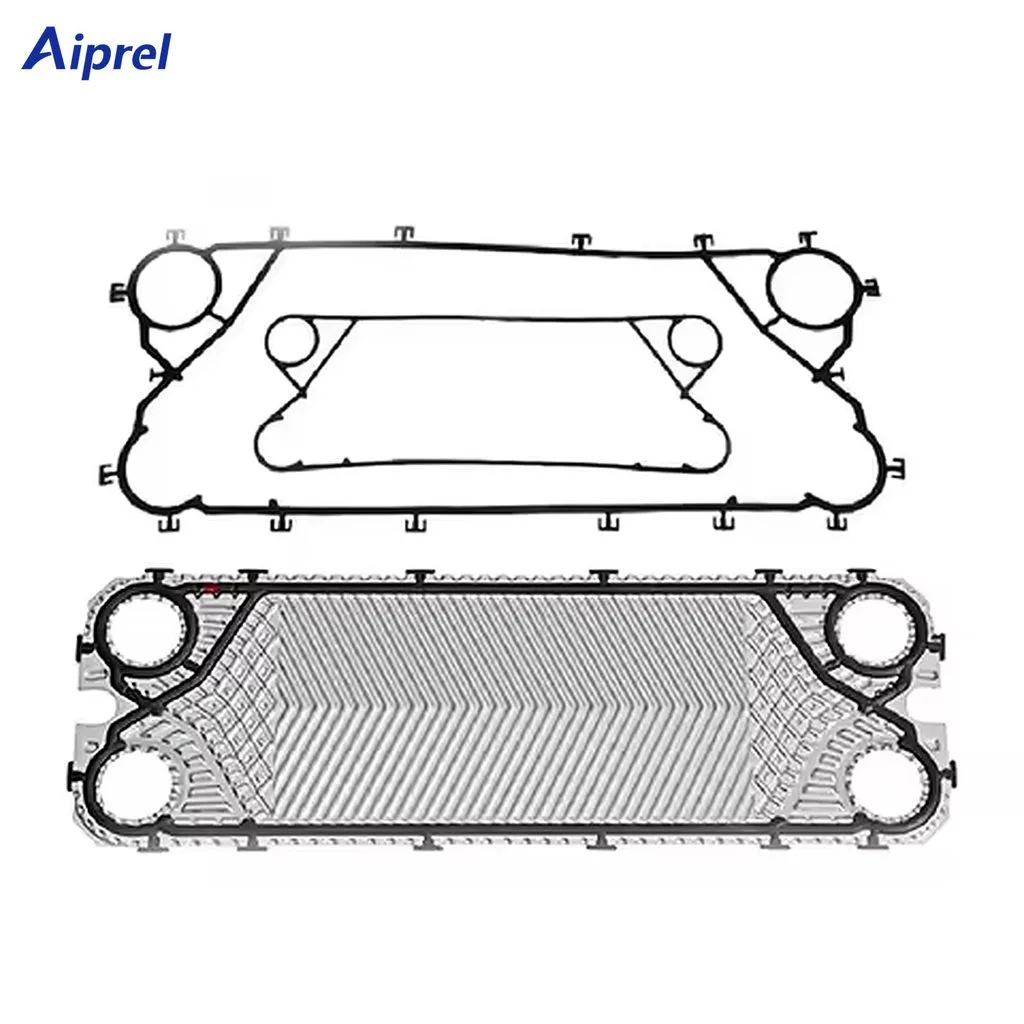
Thin, pressed metal plates form the heat transfer surface. Their corrugation pattern creates flow paths and influences heat transfer efficiency and pressure drop. Stainless steel is common, while titanium, nickel alloys and other materials may be selected for corrosive or demanding media.
Gaskets
In a gasketed plate heat exchanger, each plate has a fitted gasket that seals the channel and directs the fluids into the correct passages. Gasket material must be compatible with the operating temperature and the chemical composition of the fluid. Common options include EPDM, NBR and FKM-based materials.
Frame Plates
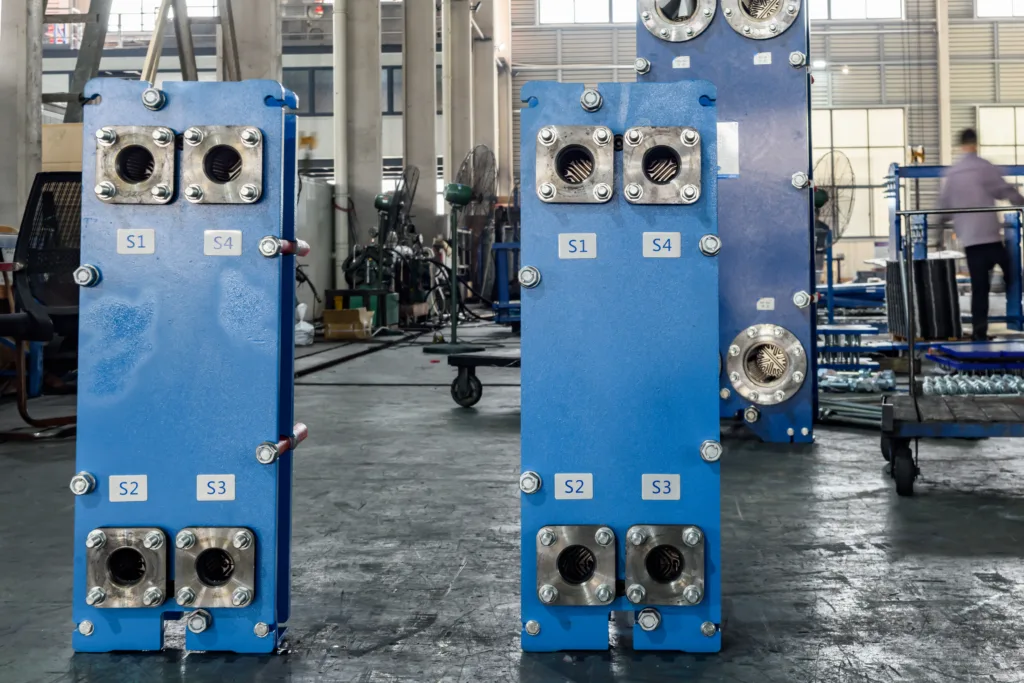
A fixed frame plate and a movable pressure plate hold the plate pack in position. The pressure plate can be moved during inspection, cleaning or plate replacement.
Tightening Bolts and Guide Bars
Tightening bolts compress the plate pack to its specified dimension. Upper and lower guide bars align the plates and support the movable pressure plate.
Connections and Ports
The inlet and outlet connections route the hot and cold media through the exchanger. Their size and arrangement are selected to suit the required flow and piping design.
Common Types of Plate Heat Exchangers
Gasketed Plate-and-Frame Heat Exchanger
This design uses elastomer gaskets between removable plates. It is flexible, serviceable and easy to expand by adding plates when the frame and process conditions allow. A gasketed PHE is frequently used for water, oils, beverages and many process liquids.
Because gasket compatibility sets practical temperature and chemical limits, the gasket material must be selected carefully.
Brazed Plate Heat Exchanger
In a brazed unit, the plates are permanently joined, commonly with copper or nickel brazing material. The result is compact and does not require frame bolts or elastomer gaskets. Brazed plate heat exchangers are widely used in refrigeration, heat pumps, boilers and other compact systems. They are not normally opened for mechanical cleaning or capacity changes.
Welded Plate Heat Exchanger
Welded construction removes or reduces the dependence on elastomer sealing between process channels. It is suited to duties involving higher temperatures, aggressive fluids or operating conditions that may be unsuitable for conventional gaskets. Different welded configurations are available, so pressure, temperature, cleanability and code requirements should be reviewed for each project.
Semi-Welded Plate Heat Exchanger
A semi-welded design combines laser-welded plate pairs with gaskets between the pairs. It is often chosen when one medium is aggressive or difficult to seal, while access from the other side is still valuable for servicing.
Get In Touch With Us
Need pricing? Need samples? Need support? Talk with our team in 24h.