How to Choose the Right Plate Heat Exchanger for Your Process
Aiprel
professor
Choosing a plate heat exchanger is not simply a matter of matching pipe size or ordering a familiar model. The correct unit must transfer the required heat, stay within the available pressure drop, resist the process fluids and remain practical to clean and maintain.
A design that performs well with clean cooling water may foul rapidly in wastewater service. A gasket that is reliable in an HVAC loop may deteriorate when exposed to hot oil or an aggressive chemical. Even an exchanger with sufficient surface area can miss the target outlet temperature if the flow arrangement or plate pattern is wrong.
This guide explains how to choose a plate heat exchanger step by step, from defining the process duty to comparing materials, construction types and total cost of ownership.
1. Start With the Process Duty
Before selecting a model, define exactly what the exchanger must accomplish. Typical duties include:
Heating a cold process stream
Cooling hot water, oil or a process liquid
Recovering heat from a waste stream
Condensing vapor
Evaporating a liquid or refrigerant
Separating two hydraulic circuits
Maintaining a controlled outlet temperature
The required heat load is commonly expressed as:
Q = m × Cp × ΔT
Where:
Q is the heat duty
m is the mass flow rate
Cp is the fluid’s specific heat capacity
ΔT is the temperature change of that fluid
The equation looks simple, but the selection should account for both sides of the exchanger, heat losses when relevant and any change of phase. If the flow rate or inlet temperature varies, provide minimum, normal and maximum operating cases. A unit optimized only for one design point may not control temperature efficiently across the full operating range.
Do not begin by specifying a plate count or heat transfer area unless an engineering calculation has already established it. These are outcomes of the thermal design, not reliable substitutes for process data.
2. Define the Hot-Side and Cold-Side Temperatures
For each circuit, provide the inlet temperature and the required outlet temperature. These four values determine the temperature program and strongly influence the required heat transfer area.
Pay particular attention to the closest temperature difference between the two streams, often called the temperature approach. A close approach can improve energy recovery, but it normally requires more effective heat transfer area and careful counter-current design.
The supplier should also know:
Startup and shutdown temperatures
Maximum upset temperature
Seasonal changes in cooling-water or ambient conditions
Whether a fluid may freeze, boil or condense
The required outlet-temperature tolerance
For example, a cooler selected around winter cooling-water temperature may fail to reach its target during summer. Supplying the worst realistic case helps prevent this problem.
3. Confirm Flow Rates and Fluid Properties
Flow rate affects heat duty, channel velocity, pressure drop and fouling behavior. State whether the quoted value is a volume flow rate or mass flow rate, and include the measurement units.
The identity of each fluid is equally important. “Process water” may describe anything from clean treated water to a chloride-rich, solids-laden stream. For reliable plate heat exchanger selection, provide:
Fluid name and chemical composition
Concentration of dissolved chemicals
Density and specific heat
Thermal conductivity
Dynamic or kinematic viscosity
pH, when relevant
Chloride content or other corrosion-related constituents
Suspended solids, fibers and maximum particle size
Tendency to crystallize, polymerize, scale or form biological deposits
Viscosity is especially temperature-dependent. If the fluid becomes much thicker as it cools, its viscosity across the exchanger should be considered rather than using a single room-temperature value.
Set the Allowable Pressure Drop
Pressure drop is the pressure consumed as fluid moves through the ports and plate channels. It is not merely a consequence to check at the end of sizing; it is a useful design resource.
Higher channel velocity can strengthen turbulence and improve heat transfer. However, it also increases pressure drop and pumping energy. Very low velocity may save pump head but can weaken heat transfer and allow deposits to accumulate.
Specify the maximum allowable pressure drop separately for the hot and cold sides. The correct value should reflect:
Available pump head
Existing system resistance
Pump energy cost
Risk of erosion with abrasive media
Fouling behavior at low velocity
Control-valve requirements
A good design balances thermal performance, cleanability and power consumption instead of minimizing pressure drop at any cost.
5. Establish Design Pressure and Temperature
Operating pressure and temperature describe normal service. Design pressure and design temperature define the limits used for mechanical selection. They should include credible startup, shutdown and upset conditions.
Also report:
Maximum pressure on each side
Expected differential pressure between circuits
Vacuum conditions, if any
Pressure surges or water hammer risk
Rapid temperature changes
Applicable code or certification requirements
These conditions influence the frame rating, plate thickness, sealing method and connection design. A process that approaches the practical limits of elastomer gaskets may require semi-welded or fully welded construction.
6. Choose the Most Suitable Construction
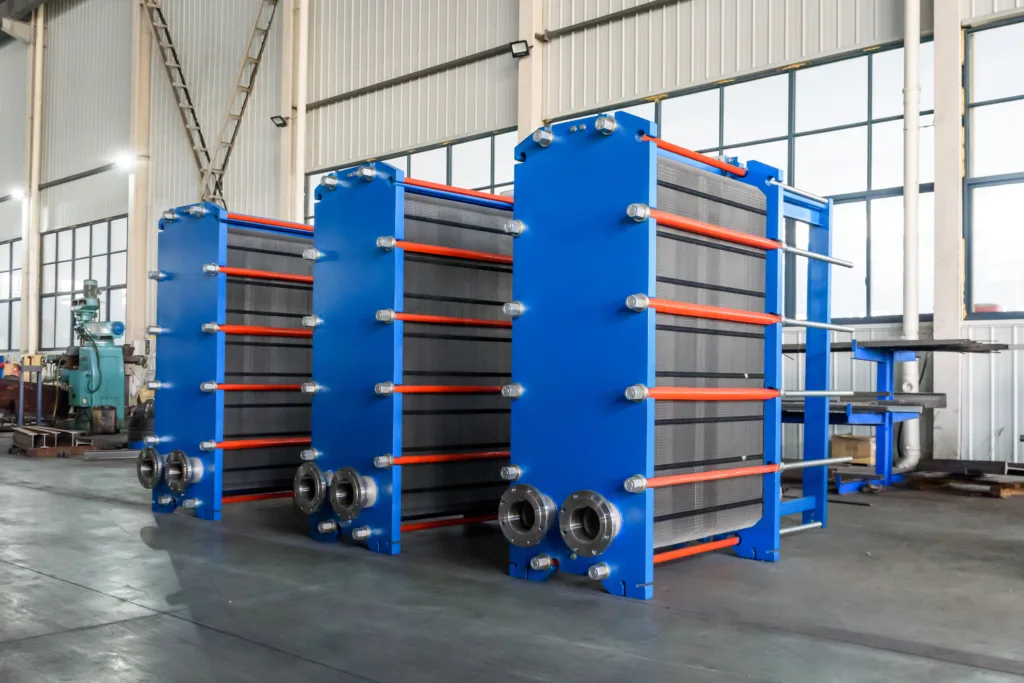
Different plate heat exchanger types solve different operating problems. The following comparison provides a starting point, but the final choice should be verified against the actual duty.
Construction
Best suited to
Key advantages
Points to consider
Gasketed plate-and-frame
Clean or moderately fouling liquids within gasket limits
Openable, mechanically cleanable, individual plates and gaskets replaceable, capacity may be adjusted
Gasket compatibility and aging must be considered
Brazed plate
Compact HVAC, refrigeration, heat-pump and boiler duties
Small, economical, no elastomer channel gaskets
Not normally openable; brazing material must suit the fluid
Semi-welded plate
Refrigerants, aggressive media or services where one circuit needs a welded seal
Reduces gasket exposure on the welded side while retaining some service access
More specialized maintenance and higher initial cost than a standard gasketed unit
Fully welded plate
Higher-temperature, higher-pressure or gasket-incompatible industrial duties
No elastomer sealing between welded process channels; compact thermal design
Capacity is generally less flexible and mechanical cleaning access depends on the design
Choose a gasketed unit when inspection, mechanical cleaning and future capacity changes are important. Consider welded construction when the process exceeds the chemical, temperature or containment capability of available gaskets. A brazed exchanger can be attractive for compact standardized systems, provided the fluids remain clean and compatible.
7. Select the Plate Material
Plate material must resist corrosion throughout the intended service life. Selection depends on the complete fluid chemistry, temperature, concentration, oxygen level and cleaning method.
Common options include:
Stainless steel 304: Often considered for clean water and mild general-purpose duties
Stainless steel 316L: Offers improved resistance in many industrial and hygienic applications
Titanium: Frequently selected for seawater and other chloride-bearing services
Nickel: Used for certain caustic and specialized chemical duties
254 SMO: A high-alloy stainless steel option for more demanding chloride environments
Hastelloy C-276 or comparable nickel alloys: Considered for aggressive chemical media where standard stainless steels are unsuitable
This list is only a general guide. Material names alone do not guarantee suitability. Corrosion behavior can change significantly with temperature and concentration. When fluid chemistry is uncertain, request a formal compatibility review and, where necessary, use corrosion data or testing specific to the process.
Plate thickness is another design variable. It affects mechanical durability, corrosion allowance, thermal resistance and cost. The thickest available plate is not automatically the best choice; the manufacturer should select a thickness that satisfies the mechanical and process requirements.
8. Select a Compatible Gasket Material
In a gasketed plate heat exchanger, the gasket performs two jobs: it seals the plate channel and directs each fluid through the intended path. Chemical or thermal incompatibility can cause swelling, hardening, cracking or loss of elasticity.
Common gasket families include:
NBR: Frequently used with oils, water and general industrial fluids within its applicable limits
EPDM: Common in hot-water, steam-related and many water-based duties, but generally unsuitable for petroleum oils
HNBR: Offers enhanced mechanical and temperature performance for selected oil and refrigerant applications
FKM: Considered for many higher-temperature, oil and chemical services
Exact compatibility depends on the compound formulation, temperature and fluid concentration. Cleaning chemicals must be included in the review because a gasket may tolerate the process fluid but fail after repeated exposure to an unsuitable cleaning solution.
For food, beverage or pharmaceutical use, specify the required hygienic approvals and traceability rather than assuming that a material is sanitary by default.
9. Match Plate Pattern and Channel Gap to the Fluid
Corrugation geometry influences turbulence, heat transfer and pressure drop. A high-resistance plate pattern can provide strong thermal performance, while a lower-resistance pattern may be needed when pump head is limited. Some exchangers combine plate patterns to balance unequal hot-side and cold-side duties.
Channel gap also matters:
Narrow channels offer high surface-area density for clean, low-viscosity fluids.
Wider channels can reduce blockage risk with fibers, suspended solids or viscous media.
Free-flow designs may be appropriate where contact points between adjacent plates would trap product or debris.
Do not filter solely to protect the exchanger without reviewing the process. The proposed strainer mesh must be suitable for the channel gap, particle characteristics and acceptable maintenance frequency.
10. Plan for Fouling and Cleaning
An exchanger should be selected for its condition after months of operation, not only for its clean performance on day one. Tell the supplier what deposits are expected and how the plant plans to remove them.
Questions to address include:
Will the unit be cleaned in place or opened for manual cleaning?
Which cleaning chemicals and temperatures will be used?
How often can the process be shut down?
Is a standby exchanger required for critical service?
Can the installed unit be opened without removing connected piping?
Is there enough maintenance space to remove plates?
Excessive thermal oversizing is not always a good defense against fouling. Adding plates can reduce channel velocity, which may encourage more deposition. A better design combines an appropriate fouling allowance with suitable velocity, plate geometry and a realistic cleaning plan.
11. Review Connections, Layout and Installation
A thermally correct exchanger can still create problems if it does not fit the plant. Confirm:
Connection size, type, rating and orientation
Nozzle loads permitted by the manufacturer
Floor space and service clearance
Foundation and lifting requirements
Vent and drain positions
Insulation or drip-tray requirements
Accessibility of tightening bolts and the movable frame plate
Whether future plate-pack expansion is required
Piping should not transfer excessive weight or stress to the exchanger connections. Protection against water hammer, freezing, vibration and sudden valve closure should be considered during system design.
12. Compare Lifecycle Cost, Not Only Purchase Price
Two quotations with similar heat duties may represent very different long-term value. Evaluate the total cost of ownership, including:
Pumping energy
Expected cleaning frequency
Gasket and plate replacement cost
Spare-part availability
Production losses during downtime
Ease of inspection and reassembly
Future capacity changes
Technical support and thermal recalculation service
A lower-priced exchanger can become expensive if it operates near its limits, requires frequent cleaning or uses hard-to-source components. Conversely, a highly specialized design may add unnecessary cost for a simple clean-water duty. The objective is a dependable fit between equipment and process.
Information to Send With Your Plate Heat Exchanger Inquiry
Use this checklist when requesting a technical selection or quotation.
Hot Side
Fluid and concentration
Flow rate
Inlet temperature
Required outlet temperature
Operating and design pressure
Maximum allowable pressure drop
Physical properties, if not standard water
Cold Side
Fluid and concentration
Flow rate
Inlet temperature
Required outlet temperature
Operating and design pressure
Maximum allowable pressure drop
Physical properties, if not standard water
Project Requirements
Required heat duty, if known
Fouling or solids information
Plate and gasket preferences
Connection standard and orientation
Construction code or certification
Cleaning method
Installation environment
Minimum, normal and maximum operating cases
Required quantity and delivery schedule
If one outlet temperature or flow rate is unknown, identify it clearly. The thermal engineer may be able to calculate the missing value from the remaining process data.
Common Plate Heat Exchanger Selection Mistakes
Avoid these frequent errors:
Selecting by connection diameter alone. Port size does not define thermal capacity.
Providing only the heat transfer area. Required area changes with temperature program, flow, fluids and plate geometry.
Ignoring allowable pressure drop. The exchanger may meet the thermal duty but exceed the pump’s capability.
Describing every fluid as water. Glycol concentration, salts, oil, solids and additives can change both thermal and material selection.
Checking plate material but not gasket material. Both must tolerate the process and cleaning chemicals.
Sizing only for normal conditions. Seasonal and upset cases may control the design.
Assuming more plates always improve reliability. Too many channels can reduce velocity and increase fouling risk.
Forgetting maintenance clearance. An openable exchanger needs sufficient space for servicing the plate pack.
Frequently Asked Questions
Can I select a plate heat exchanger from flow rate alone?
No. Flow rate is only one input. At minimum, selection also requires fluid identity, inlet and target outlet temperatures, allowable pressure drop, operating pressure and design limits.
Is a larger plate heat exchanger always more efficient?
Not necessarily. More heat transfer area may reduce the temperature approach, but it can also change channel velocity, pressure drop, fouling behavior, footprint and cost. The best selection is optimized for the complete operating range.
Should I choose a gasketed or welded plate heat exchanger?
Choose based on fluid compatibility, pressure, temperature, leak consequences and cleaning needs. Gasketed units offer convenient access and flexibility. Welded designs suit duties where elastomer gaskets are inappropriate or stronger containment is required.
How do I choose between stainless steel and titanium plates?
The decision depends on fluid chemistry and temperature. Stainless steel works well in many clean-water and process duties, while titanium is frequently used for seawater and chloride-rich media. A material compatibility review should confirm the final choice.
What information does a manufacturer need to size the unit?
Provide both fluids, flow rates, inlet and outlet temperatures, operating and design pressures, allowable pressure drops, physical properties, fouling information and material or code requirements. More complete data leads to a more reliable thermal design.
Get a Process-Specific Selection From Aiprel
Every plate heat exchanger selection is a balance between heat transfer, pressure drop, materials, cleanability and cost. Catalog data can help narrow the options, but final sizing should be based on the actual process conditions.
Aiprel manufactures gasketed and welded plate heat exchangers as well as replacement plates and gaskets for applications in HVAC, refrigeration, power, chemical processing, food and beverage, marine, metallurgy and environmental systems. Available plate materials include stainless steels, titanium and specialty alloys, with multiple gasket materials and plate geometries for different duties.
Send Aiprel your hot-side and cold-side data using the checklist above. Our team can evaluate the duty and recommend a plate heat exchanger configuration matched to your process, installation and maintenance requirements.
Optional Internal Links for the New Website
Add internal links to the following pages after their final URLs are confirmed:
What Is a Plate Heat Exchanger?
Gasketed Plate Heat Exchangers
Welded Plate Heat Exchangers
Plate Heat Exchanger Plates
Plate Heat Exchanger Gaskets
Industry Applications
Request a Quote / Contact Aiprel
Get In Touch With Us
Need pricing? Need samples? Need support? Talk with our team in 24h.